1.Celestial Forest (9:06) – Tenor Saxophone, Javanese Gamelan, Bali “large” & “small” bamboo xylophones. (The saxophone is used exclusively in the lower register to mimic the percussive range of the bamboo xylophones.) July 17,2005 2. SolarSonic 1 (4:43) September 19, 2007 3.SolarSonic 2 (4:07) September 19, 2007 4.SolarSonic 3 (4:12) September 23, 2007 – Four Guatemalan chirimias. (The down-to-earth sound of the double-reed chirimia is extended to trance-like dimensions when multiplied. In SolarSonic 2, speed of execution is the dominant factor whereas in SolarSonic 3 the “noise” quality of the instrument is emphasized. SolarSonic 1 is a mix.)
Whirling Sun Visions
Of Beatific
Sound
Explode the Mind
Like a Flaming
Galaxy
Into Light Years of Bliss
5.Ele-Fantasia (3:58) – Four tenor saxophones.(Playing in a deliberately “scribbled” manner resulted in this heady dance.) September 23, 2007. 6. DreamSong 1 (9:10) August 25 &26, 2008. 7.DreamSong 2 (6:40) August 25 &26, 2008. -Tenor saxophone & voice, Mexican hollowed-out log violin, Javanese gamelan, Balinese wood xylophone & Mali balafon.(Freely-associated voice gave a dream-like quality to this music similar to that of Indonesian wayang.) 8.Gods Within (6:01) – Tenor saxophone, Balinese gamelan, Bali and Thai wood xylophones. (Inspired by the music of Marion Brown.) July 19, 2005.9.Whirling Sun Visions (4:58) Tenor saxophone and Balinese gamelan double duo. (In the lineage of AA.) October 27, 2008. Total Time: 52:45
Musicby saxophone player Henry Kuntz has been reviewed before and no doubt on one of the occasions I wrote about the fact that the saxophone is not really my favorite instrument. I do make exceptions for those players who use the instrument in a different way, like John Butcher for instance, and perhaps also for someone like Kuntz. Even when he plays his instrument in a different way than Butcher, more traditionally, there is more to his music than just the saxophone. On ‘Whirling Sun Visions’ he offers nine works for multi-track recording, playing along with his self, but also incorporates lots of ethnical percussion, like gamelan, ‘Mexican hollowed-out log violin’, ‘Mali balafon’ and his own voice. Kuntz keeps his music ‘limited’. Dense in nature, but with few variations on the various sounds he produces. His music is minimal, but not through the use of loops. Real-time repetition of sounds, layered on top of eachother, with small variations in playing. Free play at work here of microtonal stuff, which works quite well. Neither free jazz or saxophones could interest me very much, but in Kuntz’ hands this sounds pretty well. (FdW)
Subtitled “Multi-Track Works-In-Process Miniatures”, this is a collection of pieces for overlaid saxophones, vocals and exotic percussives, although the latter are not present in all the tracks. Kuntz appears very interested in the generation of ritualistic moods through the concurrence of different pulses, the presence of the Javanese gamelan adding evident metallic/melodic tints in episodes like the opening “Celestial Forest”. But if we pretend to be transported in a parallel dimension, this recipe leads to the magnification of an innocent-sounding density, a child playing with a series of reed instruments in a room full of clocks. The segments where only amassed saxes are featured are more comparable to the gathering of seagulls fighting for food on a beach, kind of a semi-chaotic superimposition of pattern-within-pattern designs which translates into a peculiar type of entrancement, a bunch of Poppy Nogoods who have had a few too many. (Massimo Ricci, Touching Extremes)
ONE: CIRCLE-CYCLE (CD 2) | Henry Kuntz / solo tenor saxophone | Recorded January 27 1998 & June 9, 1997
listen to Henry Kuntz | C. Dimension 9. Moon Stripe Tiger | from the CD One Circle-Cycle
ONE & ONE: 12 PATHS TO KNOWLEDGE (CD 3) | Don Marvel / time machine, prophet sampler, old turntable, live signal processing and mixing; Henry Kuntz / tenor saxophone, Chinese musette and Nepalese bamboo flute. | Recorded April 18, 1998
listen to Henry Kuntz and Don Marvel | Who Knows What Is Known? | from the CD One & One 12 Paths To Knowledge
The solo saxophone music on One One & One (1997-98) is the dimensional opposite of that which appears on Wayang Saxophony Shadow Saxophone (2006). To use a shadow play analogy, the solo music on One One & One is like the movement of the brightly painted puppets (brightly lit by flickering flame) on the puppet master’s side of the screen while the solo music on Wayang Saxophony Shadow Saxophone is like the etheric trails of those movements as they appear in “negative” space.
The music with the amazing Don Marvel straddles multiple dimensions.
The following “Notes” for One One & One were originally sent only to reviewers.
ONE (HB CD 2)
In September 1996 at Beanbender’s in Berkeley, I gave the first performance of solo tenor saxophone I had given in some 15 years. The response was overwhelmingly positive, encouraging me to continue working in this format.
Henry Kuntz | Photo by Martha Winneker
From 1979 to 1981, I did a number of solo saxophone performances. The musical areas I was working in at that time are documented on the first two Humming Bird LPs, Cross-Eyed Priest(HB 1001) and Ancient of Days, Light of Glory (HB 1002), and by a single piece on the Humming Bird cassette, Atitlan/Luna Negra (HBT 004).
Key to my playing in this period were harmonic, sonic, and textural explorations and the dimensional use of space both for formal definition and as an implicit propulsive component in its own right. This playing was mainly rooted in the extreme upper range of the saxophone. From this position, I also attempted to put forth what I called a “new melodicism” which was based on the concept of working in this range for its own sake rather than simply using it as a place to land through emotional catharsis.
While I was happy with the results of these explorations, the physical demands of continuing to play in this way coupled with, to some extent, running out of room to maneuver at the horn’s high end forced me to put the saxophone aside for awhile. I was also finding many other possible instruments to play and explore, on each one of which a different “voice” of mine seemed to emerge. (The expressive results of playing many of these instruments, in various formats and to various ends, are documented on the different Humming Bird cassette releases and on Moss’Comes Silk, Humming BirdCD 1.)
Although I have never actually stopped playing the saxophone, I have only recently (since 1994) begun practicing it regularly again. This time, aesthetically speaking, I decided to make a fresh start with the instrument, drawing on all the different ways I had once played and explored, and remembering the influences of many different players who had inspired me to want to play in the first place.
At the same time, I have been drawing on the influences of electronic music and the particular ways it is possible to approach, create, and manipulate sound electronically. These are ways of playing which, while growing out of electronics, need not be restricted to that domain alone but may also be applied to playing traditional instruments. I include in my reference to electronics turntable artists, samplers, “noise” artists, signal processors, and those in still indefinable “categories” of sound in addition to persons engaged in so-called “pure” electronic music.
Technically speaking, I have sought to bring both a sense of “tradition” (or at least of my own tradition) along with a sense of exploration (of the unknown and barely-known edges of sound) to my current playing.
All of my playing, however, is based in improvisation. So the technical aspects of music-making are still only the groundwork for what is to follow — and that, of course, is always unknown.
Spiritually speaking, improvisation is to me — as I have alluded to elsewhere — akin to a form of shamanic art. Clarity of mind, psychic freshness, pleasure in playing: these are the core of true creation. These are the qualities I have sought to keep constant in all of my music.
ONE & ONE (HB CD 3)
With my expanded interest in electronics, the collaboration between Don Marvel and myself was a natural.
Don Marvel (1998)
Don is a deeply aesthetically-sensitive player who not only took the raw sonic material I provided him and uniquely re-shaped it but used it to create entirely new formal dimensions, sounds, textures, and structures that were likewise firmly rooted in the extended contours of my own playing.
Additionally, as part of the raw material of his turntable, he took the LPs I had made years ago and gave them new life, using them as formal, clipped, and distorted counterpoint to the “actual” new music — to the extent that even I am not always aware of what is the “current” playing of mine and what is not. This is not to mention the way in which he processed and mixed all of the music in the moment, creating layers of textural soundings, loops, and inter-loops, seamlessly inseparable from the original material from which they sprang.
I hope this record will serve to introduce Don’s genius to the many who I know will want to hear how he works.
I am grateful to him for helping to bring all of my music full-circle and into complete contemporaneity. Henry Kuntz, July 1998
REVIEWS:
JAZZ JOURNAL INTERNATIONAL | Kuntz … has never shunned the challenge of solo performance on tenor. ONE …shows that it remains one of his strengths. It contains 10 well-balanced improvisations, shuns lengthy, technical displays and rewards newcomers who might sample Song Bat and Thatched Circuits. Kuntz uses technique as a means to a creative end. He is well in control of multi-phonics but his one man counterpoint is used more as “parent line and decoration” than as a series of parallel melodic statements.Barry McRae (March 1999)
CADENCE | Kuntz pulls no punches when it comes to the direction that his music takes. There is only one road for him, and it leads to universes unknown…
His approach is to explore all the sound elements possible from the tenor, ranging across the frequency bandwidth from the lowest earthy tones to the highest banshee screeches. Your spectrum analyzer will touch all the bases. Kuntz takes a thread of an idea, toys with its possibilities at various degrees of the tonal register, and then launches into a massive attack of the sound form. His blowing technique consists of lightening fast alteration of the hertz level within the note clusters. Both his tenor and your ears get a full workout. Frank Rubolino (January 1999)
SAN FRANCISCO BAY GUARDIAN | Few other musicians so completely defy description. Kuntz not only colors outside the lines, he erases them and starts from scratch every time out.
And “out” this music is. The solo saxophone disc, subtitled “Circle-Cycle,” is a tour de force of sonic alchemy, produced by working breath and tongue against reed, fingers against valves. Then, with the North Carolina-based Marvel (a.k.a. Flappy), the results sound like radio static smooches and make startling dynamic leaps, from crackling whispers to white noise explosions. Derk Richardson (October 28, 1998)
OUTSIDE # 7 | This is a 2-CD package issued on Kuntz’ label – Humming Bird Records. The sixty-one and one-half minute ONE (the gold disc) is solo tenor saxophone by Henry recorded in 1997 and early ’98. It is entitled Circle-Cycle. It consists of 10 pieces in 3 separate sections, and explores sonic territory in which few, if any, have dared to venture …at least not alone, and for such an extended period.
From 1979 to 1981 Henry’s solo saxophone performances concentrated on the upper register of the instrument. He then went on to other instruments, only returning to performance on the tenor with a September 1996 solo concert at Beanbenders in Berkeley. In this concert, Henry states, “This time, aesthetically speaking, I decided to make a fresh start with the instrument, drawing on all the different ways I had once played and explored, and remembering the influences of many different players who had inspired me to want to play in the first place.”
The result is a highly original and masterful approach to the tenor saxophone. This is not familiar territory. It is like a lonely walk on a distant planet. Not those comfy close-to-home planets like Mars, Jupiter, Saturn or Venus but rather ONE man walking out there digging and turning the solidified materials with a carefully polished axe. Yes, a mineral world, full of sharp edges, deep vibrations, and short cries and exclamations of discovery. That ONE man taking this lonely creative trip may interest only a few but like most truly creative work it’s not for everybody, just those who want it. For those, a wonderful music has been made available.
The second disc ONE & ONE is Henry in duo with the electronics of Don Marvel who lives secluded in the Blue Ridge Mountains of North Carolina. Henry plays tenor, Chinese musette, and Nepalese bamboo flute. Don plays time machine, prophet sampler, old turntable, signal processors and does the mixing. The 73 minute CD (the blue disc) is an intense package of further searches into the unknown.
In a universe where everyone is forced to consume “product” from completely known and mapped sources; where taking a trip means looking out the window of standard conveyance, eating in distant Macs, and sleeping in musical Hiltons & Holiday Inns, it’s good that one can get off the beaten track. It can be difficult too. Jimzeen & Wizard (February 1999)
Genta Buana Sari and Sanggar Çudamani Gamelan Collectives; Vancouver Players (Nonet); Naoko Christ-Kato, piano; OSSIA Ensemble, David Jacobs: conductor. Recorded: Unstable Center June 19, 2003 Pengosekan, Bali; Underleaf July 9, 2006 Pengosekan, Bali; Resolution October 25, 2008 Rochester, New York; Invention and Etude February 22, 2005 Lubeck, Germany.
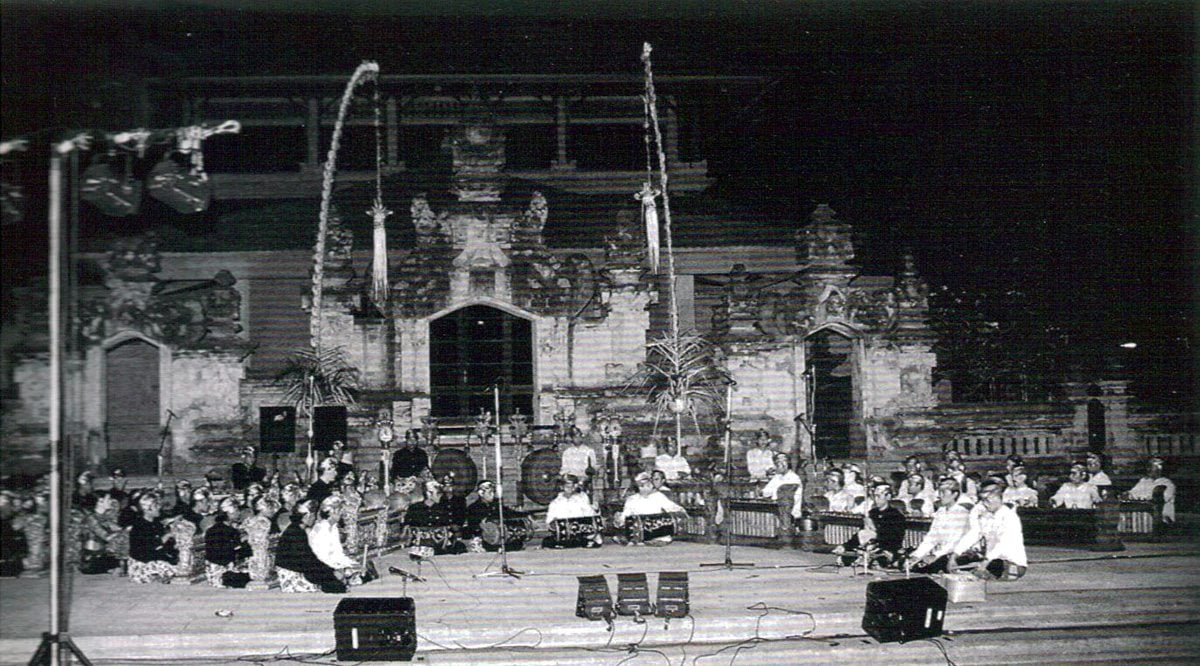
In June 2003, I was fortunate to be in Denpasar, Bali for the premiere of American composer Michael Tenzer’s piece Unstable Center for two gamelan samaradana orchestras. I wrote of the performance in my Report from Bali 2003.
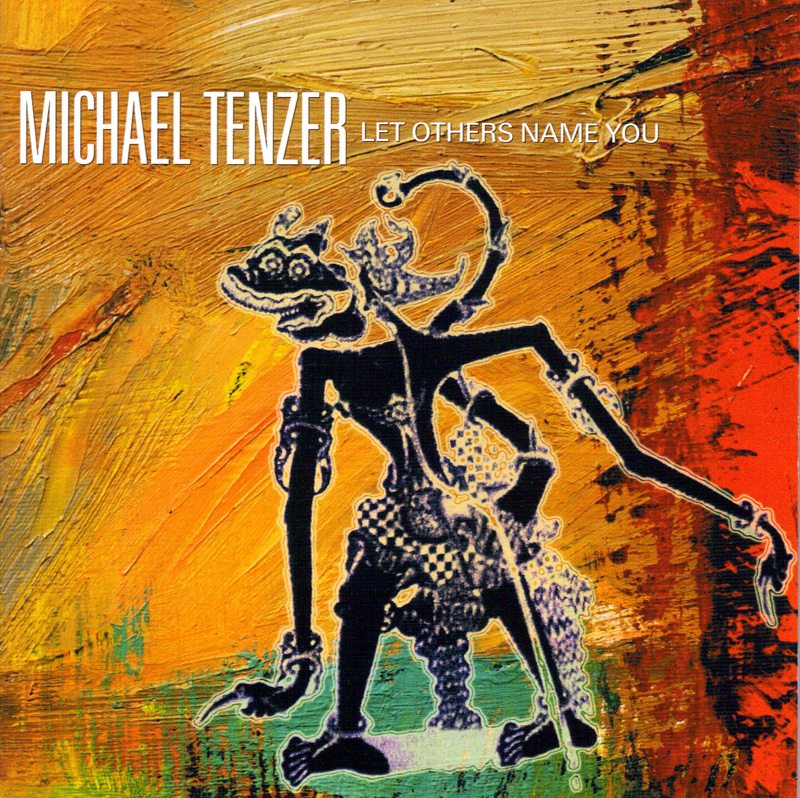
But Unstable Center was only the first part of a triptych. Now it, along with the triptych’s second and third parts – Underleaf (from 2006) and Resolution (from 2007) – can be heard in beautifully detailed recordings on Michael Tenzer’s new CD, Let Others Name You.
Unstable Center (whose Indonesian title Puser Belah translates as “split navel”) was written as a response to the Bali bombings of October 12, 2002. It asks whether it is possible to bridge the gaps between inherently different cultures and values.
The genius of Unstable Center is that it is a programmatic work rooted in purely musical advances which serve in turn to further its programmatic ends.
The samaradana orchestra which the piece employs is a relatively new type of gamelan that was developed in the 1980s by I Wayan Berata. With seven tones instead of the usual five – most Balinese music is pentatonic in nature – it can be adapted to play a variety of Balinese music. Recently, new pieces have been composed specifically for the semaradana gamelan that propose a more structurally open, multi-pentatonic, multi-modal music.
Unstable Center takes these new concepts as a given and adds another orchestra. Somewhere in the middle of the piece (and in Underleaf and Resolution as well), complex South Indian rhythmic figures and patterns are woven into the mix.
Programmatically, Unstable Center has to do with a first-time meeting between two isolated cultures, each one represented by one of the two gamelan orchestras. In performance, the orchestras faced each other across an open air stage.
The piece begins primordially, as if at the beginning of time. Each orchestra plays in its own musical universe. One plays more quietly, the other more demonstrably loud and assertive. With gradual awareness of the other, there are points of musical conflict and cooperation. There are any number of textural twists, marvelous sudden rhythmic interjections and shifts in dynamics until, at the piece’s center, a powerful yet slightly uneasy unanimity is achieved between the two bodies. It lasts only briefly. Gradually, the heady communion comes apart, each orchestra retreating into its own parameters, then finally retiring to musical spaces that mirror the opening.
In performance, there were some subtle, yet important, visual components to the work as well. In the middle of the piece, one of the two drummers from each orchestra exchanged drums, symbolic of creating a cultural bridge between the groups. And at the work’s conclusion, each of the players of the large gongs from each orchestra abandoned their posts at the rear of the stage and walked to the front. As the large gong is more or less the anchor of any gamelan ensemble, I took the musicians leaving their instruments to indicate that while the piece was finished, the process itself was unfinished; unfinished because it is an ongoing one and must be continually, freshly re-engaged in.
This leads us to Underleaf, the title of which is taken from a Balinese children’s song which suggests that one can’t simply sweep away cultural differences. They remain where they are, “underleaf.”
For Underleaf , we again have two orchestras. One is a Balinese gamelan semardana, but the other is a jazz-infused nonet with 2 clarinets, 2 saxophones, 2 trumpets, 2 trombones, and electric piano. For this piece, however, the two orchestras do not face each other; each is embedded as a complete and separate entity within the other ensemble.
Underleaf seems to be asking how two fully developed, dynamically self-contained cultural bodies can get along in close proximity.
Musically, the answer seems to be for them to each go their separate but equal ways, interacting for only an occasional gratuitous amenity. What’s interesting, however, is that Underleaf provides an additional if perhaps unintended answer to the question it poses. For as one becomes accustomed to hearing the piece, its built-in harmonic and rhythmic clashes begin to dissolve and fade. The ear begins to perceive a new musical/cultural unity. This, in a sense, is how real cultures evolve, shift, and form new wholes. People subconsciously begin to incorporate and eventually build upon new (if at times contradictory) cultural input.
Resolution, which follows, suggests even more. The piece employs a full classical orchestra and two Balinese drummers. While at first glance, the balance between the two cultural entities would seem to be unequal, we realize on reflection that each represents the essence of musical expression of the two cultures. In the west, it is the classical orchestra which carries cultural weight, whereas in Bali it is the drummers who are the leaders of the gamelan, the ones who direct and dynamically shape the music as it goes along.
Michael Tenzer describes Resolution as a “recessional,” a piece that would ordinarily be played as an audience exits a performance. As such, it both summarizes and re-capitulates what the audience has experienced, moving it out of performance time and space into real world time and space.
Building on the strength of an extensive string section, Resolution has a dreamlike, near fantasia quality to it that rises above its own inner drama to virtually hover over the first parts of the triptych. The ease of interaction between the western orchestra and the Balinese drummers suggests to us that real world problems of cultural interaction are best solved by each of us recalling the spiritual essence of who we are as human beings. While no music can solve hardcore problems of a geo-political or economic nature – most often the basis of broader cultural disputes – it can offer us, as Resolution does, the spiritual strength to confront and solve those problems.
As a recessional, Resolution suggests as well that this is an ongoing process. There can be no final resolution, only an ongoing will to resolve that must be continually refreshed and renewed in our own psyches.
Let Others Name You also contains two short solo piano pieces by Michael Tenzer, Etude and Invention (from 2004) which are rhythmic-harmonic “studies” for the final parts of the triptych. They are stunningly and passionately played by Japanese pianist Naoko Christ-Kato.
Henry Kuntz (October 2009)
More on Let Others Name You can be found on the New World Records web page by clickinghere… and on Michael Tenzer’s web page here…
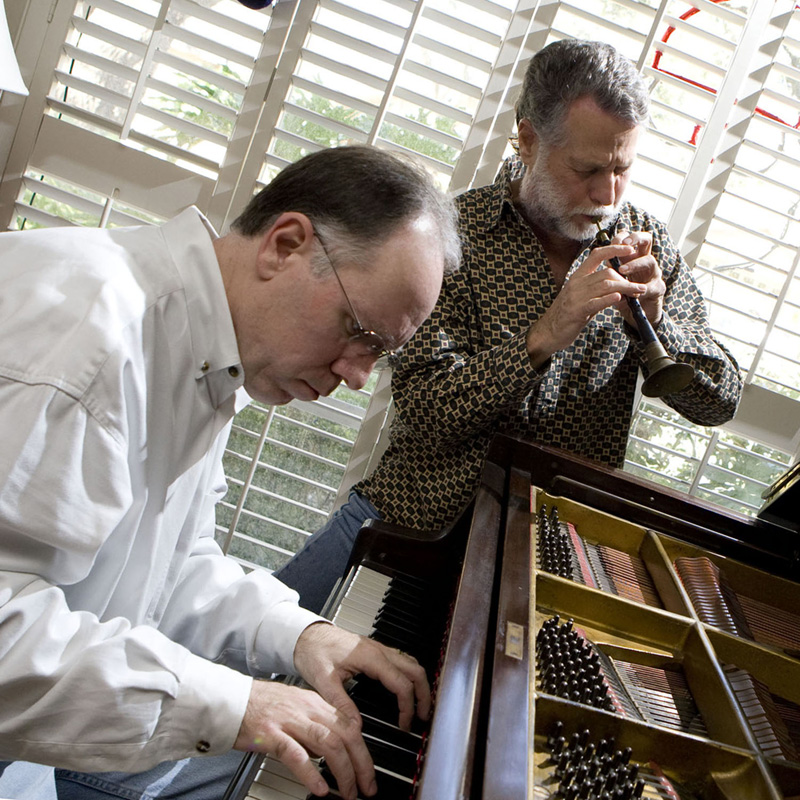
“These are the first recordings Paul and I have made together in 25 years. We had fun improvising and spontaneously shaping the music; each piece grew out of its own organic logic.” —Henry Kuntz
Paul V. Kuntz (b. 1961) began playing piano as a teenager. His fascination with jazz and free improvisation led him on an intense journey of musical discovery and self study. He delights in having a blank canvas and being able to create on the spot. Among his piano influences are Dave Brubeck, Alice Coltrane, McCoy Tyner, Keith Jarrett and Cecil Taylor.
Paul V. Kuntz is a professional photographer whose work has been exhibited in fine art galleries internationally. His photographs are in the collection of the Museum of Fine Arts (Houston, Texas), Museet for Fotokunst (Odense, Denmark), and in various private collections including that of the late Helmut Gernsheim (Lugano, Switzerland). Most recently, his work appeared in a retrospective book of Mr. Gernsheim’s photography collection, Helmut Gernsheim: Pioneer of Photo History.
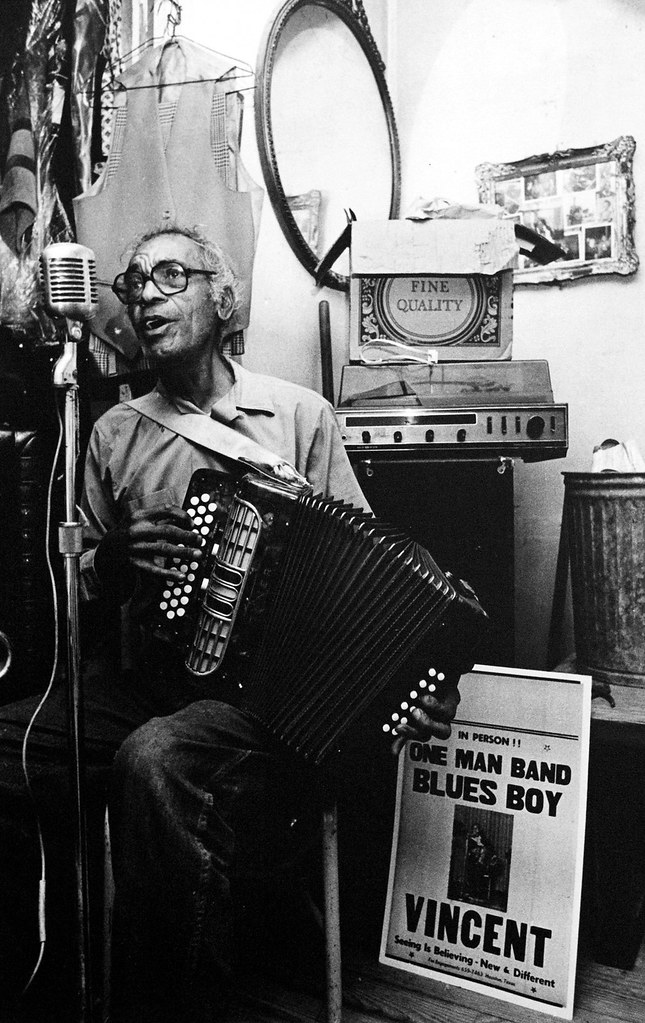
Vincent Frank playing accordion inside his home, Houston, Texas 2-26-1986 – Photo by Paul V. Kuntz
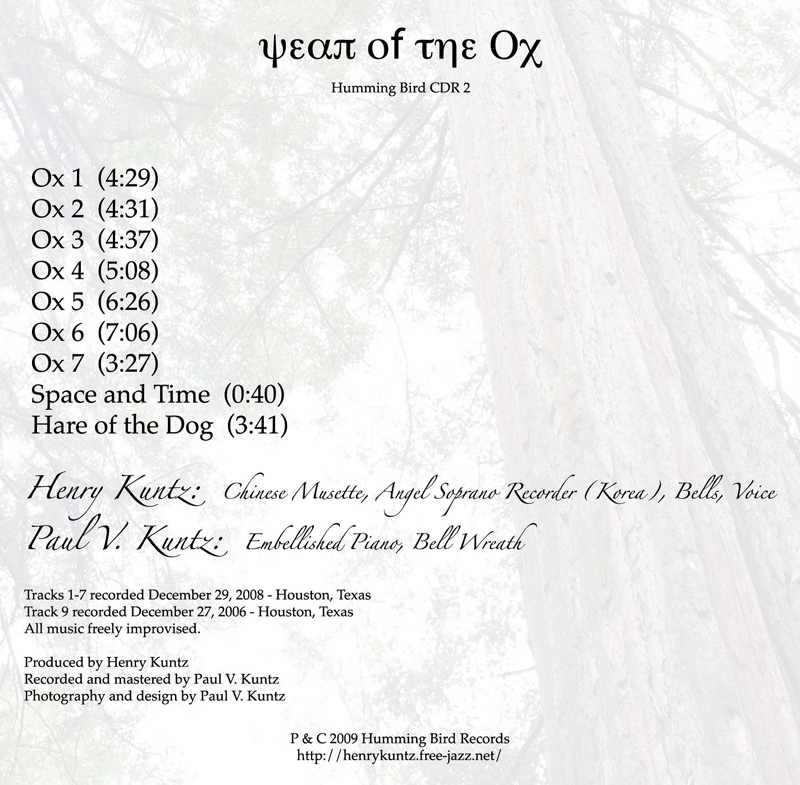
HENRY KUNTZ & PAUL V.KUNTZ – YEAR OF THE OX (CDR by Hummingbird)
Paul is a professional photographer, but plays piano since his youth with a love for jazz and improvisation. With Henry Kuntz we are in the company of a veteran improvisor. We first hear him on a very early record of Henry Kaiser, “Ice Death” (1977). And two years later Kuntz started Hummingbird and released his first solo-album “Cross-Eyed Priest”. Releases over the years were not many. Concerning this new release Kuntz says: “These are the first recordings Paul and I have made together in 25 years. We had fun improvising and spontaneously shaping the music, each piece grew out of its own organic logic.” The reason for this long gap remains is not given. Also whether we are are talking here of two brothers, father and son, or another (family-)relation is not made explicit, but of course of secondary importance. But let’s come to this meeting. Henry Kuntz plays chinese musette, angel soprano recorder, bells ,voice. Paul Kuntz embellished piano, bell wreath. We find them in nine concentrated improvisations, each one starting from a different angle. The music comes to you very direct. It is of great purity and rawness, unpolished. This makes that the music has an immediate emotional impact, although it are very abstract improvisations. Like in ‘Ox 1’ Kuntz produces often very penetrating sounds from his instruments, whereas Paul attracts attention with his self-made prepared piano turning it into an almost percussive instrument. In ‘Ox 2’ Henry excels in (fake) japanese vocals. Virtuosity is not their thing. The music lacks ego and pretensions. It springs from a meeting between two very personal and dedicated players. Authentic music! (DM)
The simpler instrumentation (Chinese musette, Korean soprano recorder, bells and voice against “embellished” piano and bell wreath) makes for a straightforward path to the immediate understanding of the music, which grabs the attention via the obvious contrast between the respective approaches. We’re told that Paul Kuntz’s pianism has been partially influenced by people such as Cecil Taylor and Alice Coltrane besides “regulars” as Dave Brubeck and McCoy Tyner, but you won’t find no eruptions or cascades here. The structure of the large part of the pieces sees the piano underlining – typically quite calmly and evocatively – single strained notes and cried-out overtones halfway through forest calls and liberation of inner tensions. If, at times, this might generate the impression of a chance meeting with an overall sense of unglued parts and bizarre intrusions, one also clearly detects the feel of non-constriction by stylistic necessities, and appreciates the honesty that appears to drive the brotherly quest for unusual communication. — Massimo Ricci, Touching Extremes

 HENRY KUNTZ – WHIRLING SUN VISIONS!