
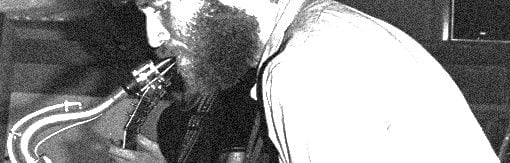
There’s a tremendous amount of musical activity in the San Francisco Bay Area right now, more than one person can keep up with.
On a recent Saturday evening, while Evan Parker appeared with pianist Greg Goodman in Berkeley at the opening of a series of performances celebrating thirty years of Woody Woodman’s Finger Palace, the “XXXth WoodTenniel,” across town in Oakland there was a new presentation of Tom Djll’s “politically expedient musical” Mockracy featuring no less than twenty stellar local improvisers.
On the following evening, while I was joining the trio Wiggwaum for a show at San Francisco’s Hemlock Tavern, Mockracy continued in Oakland, and Gino Robair mounted an encore performance of his opera I, Norton at SF’s Community Music Center. There were also performances at the Musicians Union Hall in San Francisco presented by Rent Romus and Outsound and at Studio 1510 in Oakland.
Two days later, when guests Paul Lytton and Nate Wooley joined Mills composer-in-residence Fred Frith for a collaboration at Oakland’s 21 Grand, the show was followed by an after-hours event at the nearby Uptown Club by the quartet that appears on the CD Jus.
This is all to say that while my intention is to alert you to some of the wonderfully fresh sounds happening in the Bay Area, what I have to share with you is by no means exclusive.
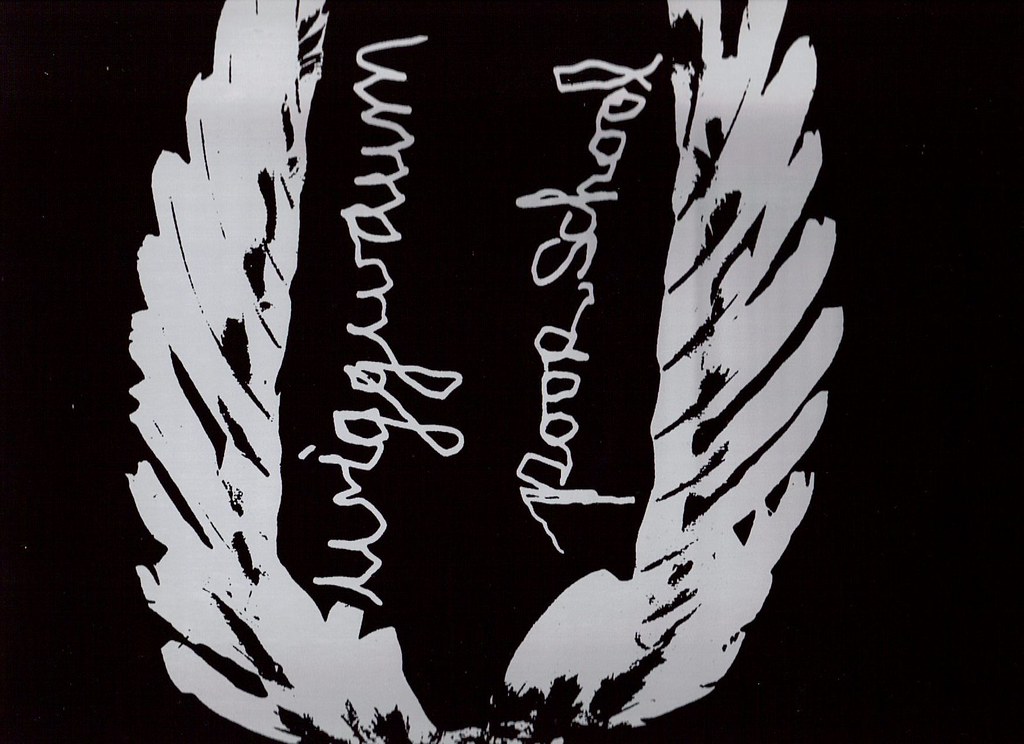 Poor School / Wiggwaum (Killertree Records) is a first release by two distinctive trios in a combination LP and CD. Poor School is Bryan Ramirez – electric guitar, Nathan Hoyme – reeds, John Niekrasz – drums. Wiggwaum is Randy Lee Sutherland – drums, Douglas Katelus – Fender Rhodes electric piano, Loren Means – amplified trombone, flute, and voice. One continuous side of the LP is Poor School, the other Wiggwaum; the enclosed CD features the LP material in digital format along with an additional track by each group.
The playing is high-intensity throughout, though there are fundamental differences in each group’s musical approach. I’ve come to think of their respective approaches as symbolic of something like post-nuclear morning and evening ragas.
Poor School will wake you up and not take you down. Their modal and thickly drone-based song is awash in a sea of harmonics. Their music seems like a throwback at first, but it’s only that there’s a timelessness at the spiritual core of it. Ramirez’s high-strung electric guitar pyrotechnics most often take the lead in the trio’s rock-solid amalgam of ecstatic psychedelic jazz.
Wiggwaum shapes sound inside a nebulous cone of white noise from outer space. Their music might change your evening or your life. While its particles are made up of “real” sounds derived from real instruments, it is pushed to such a level of intensity that only a massive sound entity remains.
Randy Sutherland’s drums loosely thrash, crash, explode, and dryly implode within the sonic mush. From Doug Katelus’ Fender Rhodes come jangly runs of Ra-like “cosmic tones” or warbly layers of static-y stratospheric dis-chords that shatter and whir upon terrestrial re-entry.
At the center of the maelstrom are the distorted voice, feedback flute, and mutant trombone of Loren Means. You might recall Loren’s playing from Henry Kaiser’s Ice Death (Parachute 005). Loren’s new brass sound is like nothing you’ve heard, a muffled foghorn to guide approaching aliens. Combining crescendo-ing and decrescendo-ing globs of sound with Martian voice and Theremin-like feedback, Loren’s playing gives shapeless shape to Wiggwaum’s edgy next-age noise music.
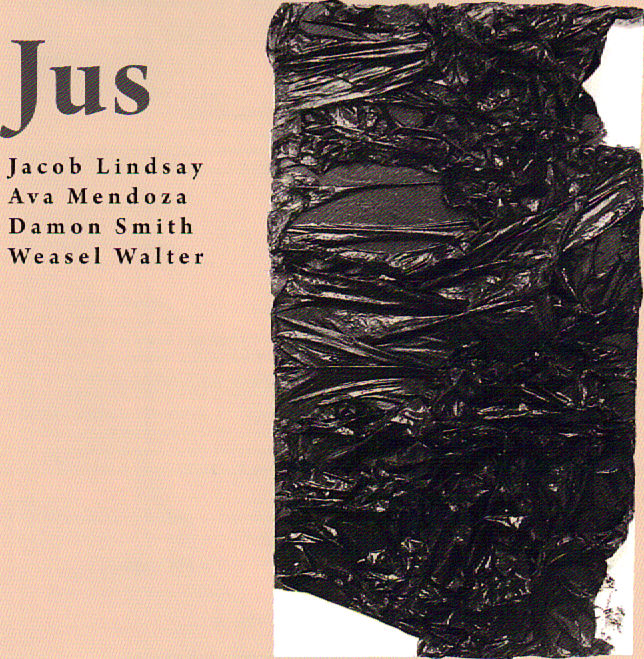 Jus (Balance Point Acoustics) is a quartet with Jacob Lindsay – clarinets, Ava Mendoza – guitar, Damon Smith – ergo string bass and lloop software, Weasel Walter –drums. Walter’s presence on the CD, along with enclosed instruction to play it “at high volume” has one thinking that this might be another high-propulsion free jazz blowout. But Jus offers music of another sort, something unique to itself.
It is music that is continually probing beneath its own surface, extracting unassuming yet purposeful sonic core samples from its oceanic depths. The sounds are low-level, deliberately dynamically uneven, but occasionally something hard is struck, and there are loud explosive bursts and eruptions.
If there is an antecedent for Jus’s musical approach, you might find it on “Translucency” where, at its most active, the music calls to mind that of the Music Improvisation Company of the early 1970s.
Jus undertakes a total group approach to improvisation. Save for Jacob Lindsay’s short Giuffre-like clarinet lead that stands in high relief on “Discrete Flavor Symmetry,” there is little in the way of individual motivic development. Yet the music engages us because despite its lack of linearity, there is held tension in the lack of line itself, in the multiple little dramas that emerge in its intervallic spaces.
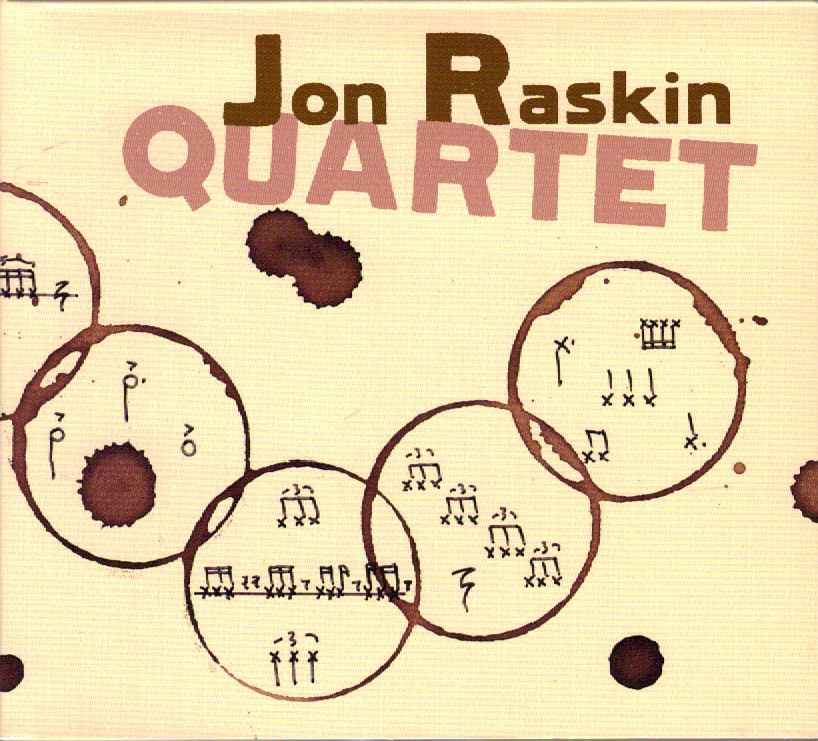 The Jon Raskin Quartet (Rastscan) features Liz Albee – trumpet and percussion, George Cremaschi – bass and electronics, Gino Robair – percussion and electronics, Jon Raskin – saxophones. There are twelve pieces of music, several based on specific-to-open graphic scores created by Raskin, others completely improvised.
Of the compositions, Raskin writes: “The scores are an ongoing attempt for the musical ideas and inspirations to be on the page rather than an abstract road map….Each work has a unique set of sounds, strategies and ideas given to the visual elements. Some of the elements in the score are composer defined while others are what I call ‘self composing’ where the musician decides on the material for the performance. The intent is to give shape and consistency of form for the ensemble while leaving open the path for individual language and perspective.”
The musicians are well chosen for that task and for their adeptness at collective improvisation. In fact, there are no real solos in this music, only continually evolving group interplay of the highest order. Individual virtuosity is fundamental to the quartet’s contrapuntal improvisational approach, but it is tempered by musical necessity. What we hear in the music are lines and riffs, weight shifts, and textural openings. Any player may stand out at this moment or that, but the integrity of the music as a whole is what we hear.
I also found myself thinking of certain music of Roscoe Mitchell’s or that of the early Art Ensemble of Chicago while listening to this CD, in the way the music devolves from line to pure sound and back again. It is interesting that in this context Gino Robair’s “deconstructivist” approach to percussion frequently leads directly back to the “little instrument” sounds of Mitchell and the AEC.
There are equally compelling contributions from Jon Raskin himself whose manner of understatement or of tonal pivoting can remind one of Mitchell; from the undersung George Cremaschi whose bold fibrous bass tone holds the music’s firm center; and from Liz Albee whose trumpet first conjures up Don Cherry, then whispers, growls, purrs, or can sound like an aggregate of children’s squeeze toys.
 Zen Kaiju is an intriguing new CD featuring Kiku Day – ji-nashi shakuhachi, and Henry Kaiser – electric and acoustic guitars.
When Henry handed me this CD, he told me he thought this was one of his best recordings ever of pure free improvisation.
But what is at the core of free improvisation, and how are we to judge it? After all, free improvisation is only one method among many for creating music. But it is the most open method, one that suggests that while it is possible to play almost anything, what that “anything” is will be determined in the moment of musical transaction. The self that enters into and surrenders to such a methodology will not likely be the same self who comes out of it at the end. For what is built into that open way of creating is an inherent propensity for change, an opportunity on each and every occasion to renew and rediscover the self and the self in relation to others. The idea is not simply that the players should engage as musical chameleons but as full, present, and evolving selves.
That is what Henry Kaiser and Kiku Day do masterfully on Zen Kaiju.
Kiku Day takes that most ancient of Japanese flutes, the shakuhachi, into new dimensions. Mindful of the still center of the instrument, she merges its traditional plaintive call with seeming electronic slivers of high-pitched sound, dynamic whooshes, breathy and growly wisps, mouth noises, strange percussive tongueings and tappings.
Henry Kaiser’s post-Bailey guitar slows down, becomes charged and evocative. He bends and alters his phrases, strums successions of stringy, twangy slack tones, flicks quick starry clusters of notes into incongruous orbit. On electric guitar, he holds in place big chunky motorboat chords; he sustains into infinity loud wavery-to-pure tones, cries, and wails that at times mimic Day’s shakuhachi.
Henry Kaiser and Kiku Day — between them emerge moments of interactive clarity that reveal the essence of their musical personas. Their mastery of free improvisation is revealed.
Henry Kuntz (November 2008)
(Thanks to Martha Winneker for editorial assistance.)


 George Cremaschi was born in New York City, and studied jazz at Jazzmobile in Harlem, composition at Greenwich House Music School in Greenwich Village, and improvisation at countless Downtown dives. Recent years have seen many performances and collaborations in the US and Europe with such renowned musicians as Evan Parker, Marshall Allen, Andrea Parkins, Gert-Jan Prins, Mats Gustafsson, Paul Lovens, Nels Cline and Saadet Türköz among others. As a composer, he has written nearly 100 pieces for chamber groups, small ensembles, solo contrabass, electronics, cinema, spoken word, dance and theater. He divides his time between Oakland and Tábor, Czech Republic, where he is an artist in residence, curator and administrator at Cesta, an international arts and cultural residency center.
 Tom Djll, born Indiana, 1957. Studied music at Berklee School of Music, the Colorado College, the Creative Music Studio, and Mills College with Anthony Braxton, Roscoe Mitchell, Karl Berger, Lester Bowie, Leo Smith, George Lewis, Pauline Oliveros, Alvin Curran, and many others. Tom has spent over twenty years (ab)using the trumpet as an analog flesh synthesizer. He has made a lifelong study of the art of improvised music, and has been performing since age seventeen. He has performed with Natsuki Tamura, Andrew Voigt, Biggi Vinkeloe, Chris Brown, Gianni Gebbia, Steve Adams, Fred Frith, and many many others. Tom Djll also writes about music for The Wire, Signal To Noise and other publications.
  Greg Goodman is one of America’s most distinguished improvising pianists. He is just as distinguished when he is in Europe. He was also very distinguished when he was in the Soviet Union in 1989, but it is still not clear whether or not Russia is part of Europe, or if it should be. This ordinarily would not affect Greg Goodman, or his distinguished career; at least, not in his opinion. For the purposes of this biography, Greg Goodman has worked with many of the world’s leading improvisers, including John Cage, Nicolas Slonimsky, and his Mother; he has also worked with many who did not lead. When not working, he is the proprietor of Woody Woodman’s Finger Palace, the San Francisco Bay Area’s longest running (since 1978) presenter of avant-garde music and theater. He also runs (from) the famous Beak Doctor Records. Currently, he is writing this sentence.
  Phillip Greenlief, since 1982, Saxophonist/Composer. He has performed internationally in a variety of settings. Greenlief’s recordings and performances have received critical acclaim in many national jazz publications (Down Beat, Jazz Times, 5/4, Cadence, Modern Saxophone, All About Jazz, The Los Angeles Times, etc.), as well as residing on many Critics Top 10 lists. His duo recordings of improvised music with bassist Trevor Dunn and drummer Scott Amendola received 5 stars in the 1999 Music Hound Jazz Essential Album Guide. Phillip is the founder of
  Cheryl Leonard. Glass shards and pinecones, glaciers, boxspring mattresses, a flock of accordions, circular saw blades, viola, the erhu, hyenas and whales and elk, Cheryl E. Leonard’s works explore subtle textures and intricacies in sounds not generally considered musical. These investigations often include the creation of instruments, primarily from found materials. She has been awarded residencies at the Djerassi Resident Artist Program, Engine 27, Villa Montalvo, and The Lab (with RK Corral), and has been honored in New Langton Art’s Bay Area Awards Show. Recordings of her music are available from Ubuibi, Great Hoary Marmot Music, Pax Recordings, Apraxia Records, 23 Five Inc, Old Gold Records and The Lab. In addition to her musical endeavours Leonard is a mountaineer, studies aikido and Chinese landscape painting, and collects pinecones with handles.
 Dan Plonsey is known as a composer, saxophonist, concert presenter and teacher of mathematics at Berkeley High School. He has written music for the Bang on a Can All-Stars, Toychestra & Fred Frith, Santa Cruz New Music Works and the Berkeley Symphony, but most of his music has been for his own ensembles, as documented on a dozen CDs. He has performed and recorded with Anthony Braxton, Eugene Chadbourne and Tom Waits, but more frequently with local greats John Schott, John Shiurba, Robert Horton and many others. Plonsey is currently at work on an opera, in collaboration with Harvey Pekar (of American Splendor fame.)
 Gino Robair is a percussionist, music journalist, and published composer living in the San Francisco Bay Area. Gino frequently tours North America and Europe as a soloist and often improvises in ad-hoc groups. He has performed and/or recorded with Anthony Braxton, Tom Waits, John Butcher, LaDonna Smith, Otomo Yoshihide, Eugene Chadbourne, John Zorn, Nina Hagen, Thinking Fellers Union Local 282, Myra Melford, ROVA Saxophone Quartet, The Club Foot Orchestra, and he is a founding member of the Splatter Trio.
  Damon Smith, born Damon Jesse Smith on oct. 17th, 1972 in Spokane, WA. Did “freestyle bmx” bicycle riding (a much more dangerous forshadow to “freestyle” music!) from age 13 to 23. Started music in 1991, under the influence of Mike Watt (Firehose & The Minutemen) on fender bass. Lead several punk/art rock combos until 1994. Upon receiving Peter Kowald’s landmark lp “Duos;Europa,” Damon sold the fender bass and concentrated solely on double bass and free music. Damon’s music is rooted in the tradition of “free jazz”, and has worked with many of the leading voices in that idiom, including Cecil Taylor, Peter Brötzmann, Frank Gratkowski and Joëlle Léandre.
  Kenneth Atchley is a sound, video, and installation artist who fashions and performs works ranging from pure-tone and noise hymns to distortion-studded, richly harmonic, electro-acoustic devotionals. Since 1997, his work has included the use of fountains as sound-sources, objects, environmental and metaphorical elements. His work continues to be informed by and abstract that work and study. Atchley’s music and installations have been featured in venues ranging from U.S. hardcore-noise dungeons and New York dance lofts, to art galleries and performance cellar circuits of Europe. Atchley’s CD of solo, electro-acoustic-noise works Fountains was released by Auscultare Research. His duet with John Bischoff has been released on Bischoff’s 23Five CD “Aperture”. profile of his work was included in the June, 2005 issue of The Wire (#256).
 Laetitia Sonami was born in France and settled in the United States in 1975 to pursue her interest in the emerging field of electronic music. Since 1991 she has developed and adapted new gestural controllers to musical performance and composed works with these materials. Her unique instrument, the lady’s glove , is made out of black lycra and is embedded with sensors which track the slightest motion of each finger, the hand and the arm. The performance thus becomes a small dance where the movements shape the music. he has been performing in numerous festivals across the United States, Canada, Europe and Japan, among which the Ars Electronica Festival in Linz, the Bourges Music Festival in France, the Sonambiente Festival in Berlin, and the Interlink festival in Japan. She lives in Oakland, California and is currently guest lecturer at the San Francisco Art Institute, and Milton Avery Summer program at Bard college.