
JOURNEY TO ITALAQUE Part I.
An Andean Adventure in Four Parts
By Henry Kuntz
Part One: Finding the Way
In South America, where seasons run counter to those in the north, it was the fall of 1986. As I crossed the Peruvian border into Bolivia — in the midst of a five-week trip — little did I know that I was about to embark on one of the most exhilarating yet harrowing journeys of my life.

A principal goal of mine in coming to Bolivia – whose population is 60 to 70 per cent Indian — was to attend an intriguing Andean festival in the village of Italaque. I had read, in Lynn Meisch’s Guide to El Dorado and the Inca Empire, of an event on May 3rd of each year, the feast of the Discovery of the Holy Cross. This was to feature a contest among groups of sikuri or panpipe players from surrounding areas who had undergone musical training there. Italaque holds near-legendary status in the region for the high level of its players’ musicianship.
The only problem was that I had been unable to locate the village on any country map I had seen. So upon arrival in La Paz — the world’s highest capital city, sprawling compactly around a bowl-shaped stone canyon at 12,000 feet — I immediately went to the tourist office, a tiny kiosk on the esplanade of a wide boulevard, for the purpose of obtaining directions.
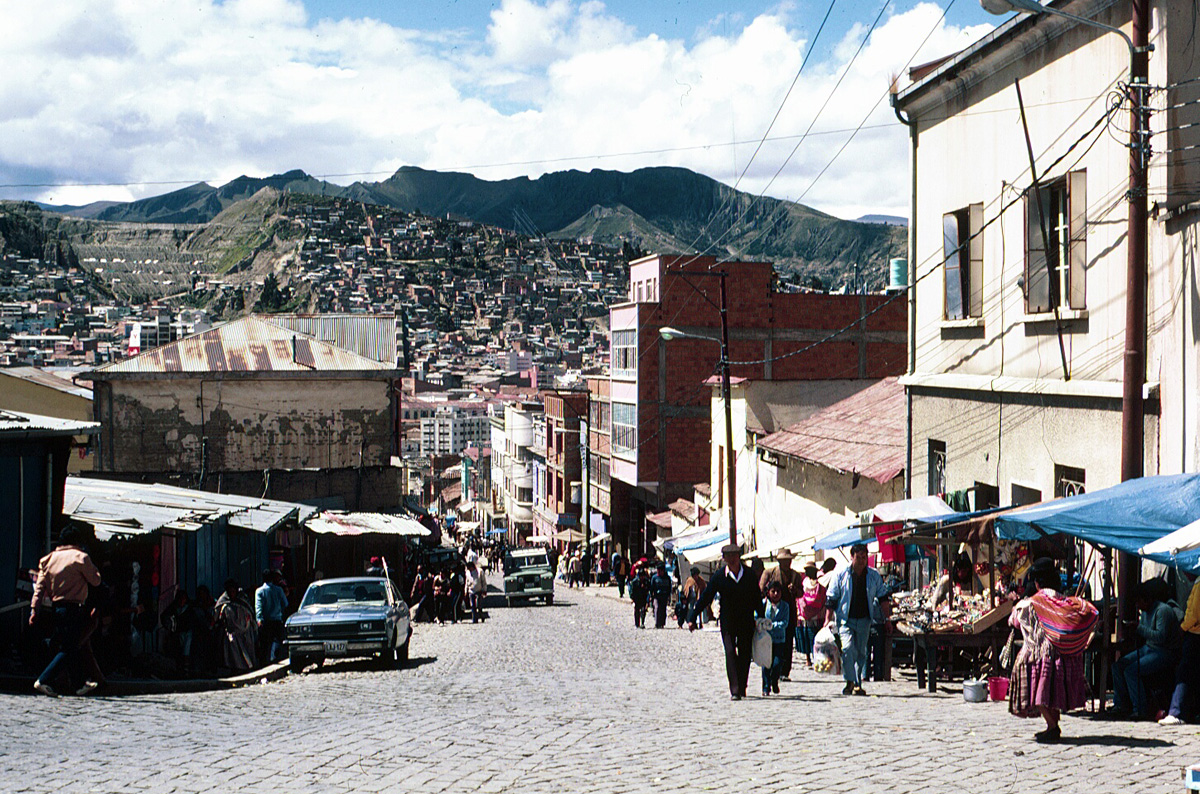


There I met Australian Patrick Hanson and American (and Australian resident) Josh Ahrens who, excited upon learning of the Italaque festival, were intent to join me on the journey.
They were thirtyish in age, flaunting a spirited youthful enthusiasm. I was two months shy of turning forty.
We found the village on a detailed map, high up the far slope of Lake Titicaca. (Lake Titicaca – at 12,500 feet – is the world’s highest navigable lake and the second largest in South America, covering 3,200 square miles.) This side of the lake, the northeastern one, is little traveled by foreigners. The border which runs between Peru and Bolivia there, and which continues diagonally through the lake, affords no legal entry or exit points from either side of the frontier.
So the first response to our inquiry from the woman behind the counter was an attempt to discourage us. “No es una area turistica,” she warned, in a forbidding and foreboding tone we, in our naiveté, cavalierly shrugged off. She said that the only way for us to make the journey was to hire a driver whose services would run U.S. $300. Since each of us was living on between $10 and $15 a day for all expenses, that sum was out of the question. Even dividing the cost three ways, that would minimally come to a week’s budget for each person. *
There had to be another way, we thought. After all, locals were somehow doing the trip. So we asked around and discovered the cobbled back street where transport to that part of the country departed. And it was there we presented ourselves in the cold, clammy darkness of the early morning of May 1st.
What type of transport we expected to get, I can’t recall, but what we boarded – with a packed crowd – was a large, open flatbed truck, a raised beam running the length of its center and its sides flanked by wooden fencing. (In the Andes, one discovers that while buses, and to a certain extent trains, ply the major routes, other travel needs are met by trucks such as this, commandeered by private drivers, who may or may not combine their runs with other business.)
Truck etiquette seemed to be to place one’s belongings beneath oneself to sit on. That presented a certain logistical problem for me (packing camera, cassette recorder, and a three-foot long wood bass flute and several LPs I had purchased), but most people had with them only large mushy bundles of things tied together by blankets, and the floor of the flatbed was stacked and carpeted with these.
The prime seats were behind the truck’s cabin, held on to dearly by several oversized Indian women who leaned comfortably back, uniformly attired in their wide indigo skirts and colorful rainbow wraps, their heads sporting the always-fashionable dark bowler hats.
People began securing their places in the truck around 6:00 AM. It wasn’t until after daybreak, 8:00 AM, that we finally began our snail-like ascent from the city’s cavernous gorge. Hovering above the metropolis in the distance stood its majestic “guardian,” snow-packed Mount Illimani, gazing caringly down from 20,000 feet.
We passed over the canyon ridge and onto the altiplano, the vast high tableland stretching from northern Chile to central Peru between the two main eastern and western Andean cordilleras or ranges. Traces of the eastern cordillera could be seen in the distance; the plateau itself was wide and endless.
Everyone was well bundled because, although it was a spectacularly bright and sunny day — the Andean sun is in fact, due to the thinness of the high altitude atmosphere, the hottest direct sun I’ve ever experienced — the air was cold, heightened by a chilling wind from the moving vehicle. The Indian women further anesthetized themselves to the temperature by steadily chomping on clumps of dry coca leaves.
I should say a few words about the altitude, because for most of a month, I lived at or above 12,000 feet. Being at that altitude is not simply being at an elevation but being in an elevated state. Following a headachy day or two of personal acclimatization, there comes an amazing sharpness of perception – and atmospherically, everything is sharper — and a clarity of mind unlike what one normally experiences at lower levels. It is not unlike being stoned.
As the truck clattered past the canyon’s rim, we were struck by the appearance of clusters of dusty, unkempt red clay barrios. Only the poorest lived in this windswept area, descending daily to work in the less harsh climate of La Paz. Gradually, nature reclaimed the space until we were riding not far from Lake Titicaca itself, its glassy waters gleaming sky blue in the morning light.
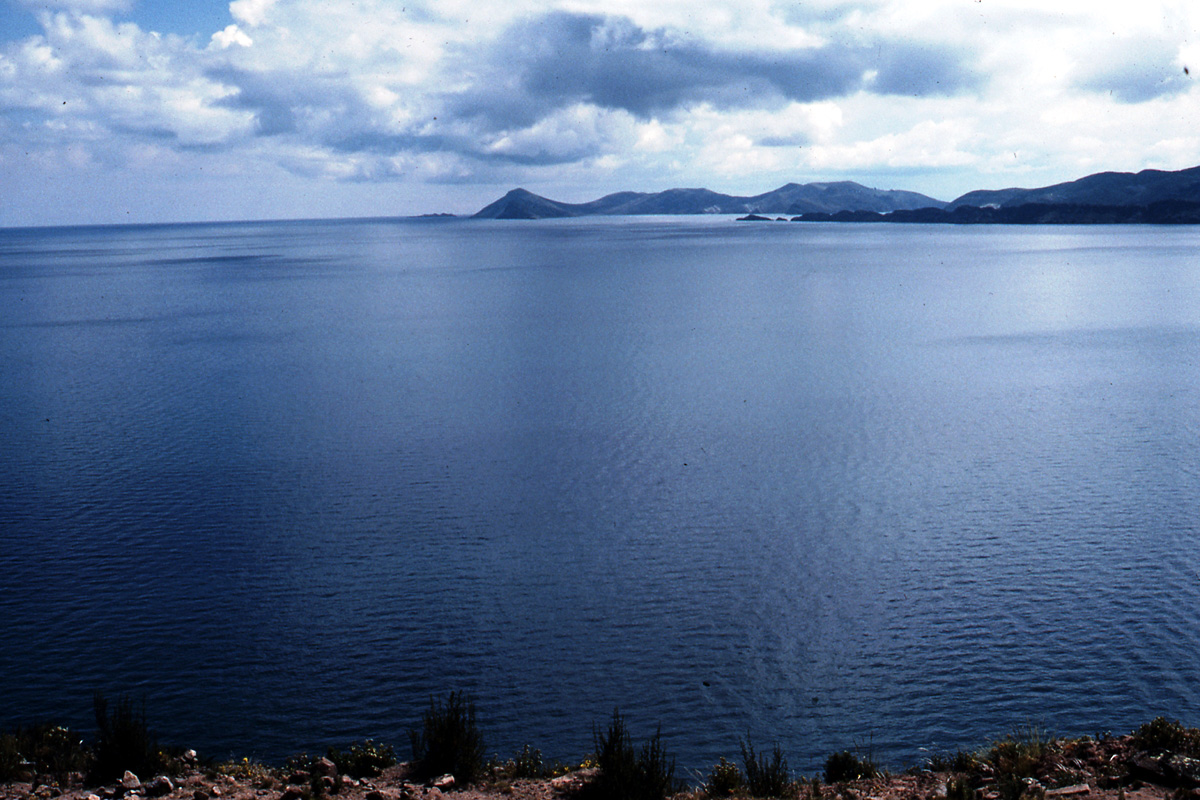
By early afternoon we arrived in the town of Escoma, two-thirds the way up the Bolivian portion of the lakeside. A road runs from there to Italaque, so we had thought to depart the truck at that juncture and secure other transport. But we were told nothing was moving in that direction anytime soon and that it would be better for us to continue on to Puerto Acosta, the last town of note before the Peruvian border; from there, we could get to Italaque.
Escoma was well into one of its own yearly festivals. No one was going anywhere. Our driver took off: for a meal or to join in the celebration, we didn’t know. Meanwhile, we waited uncertainly on the truck.
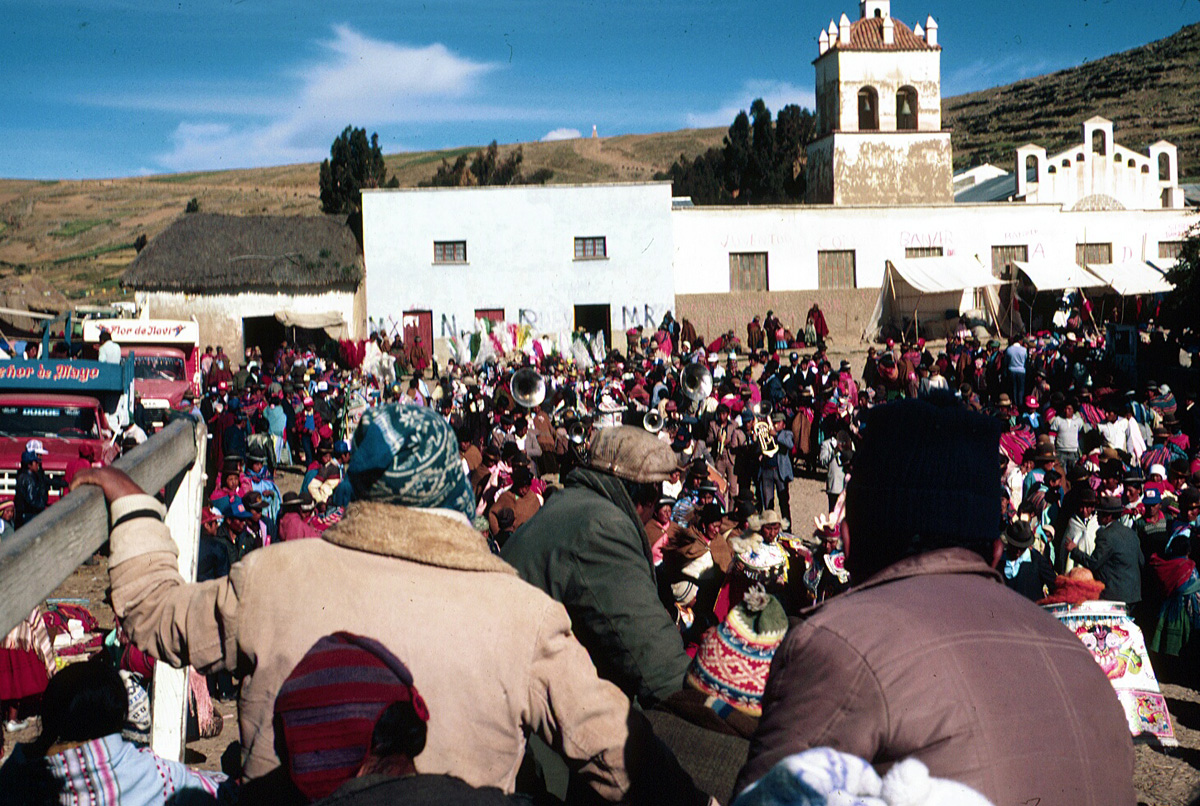
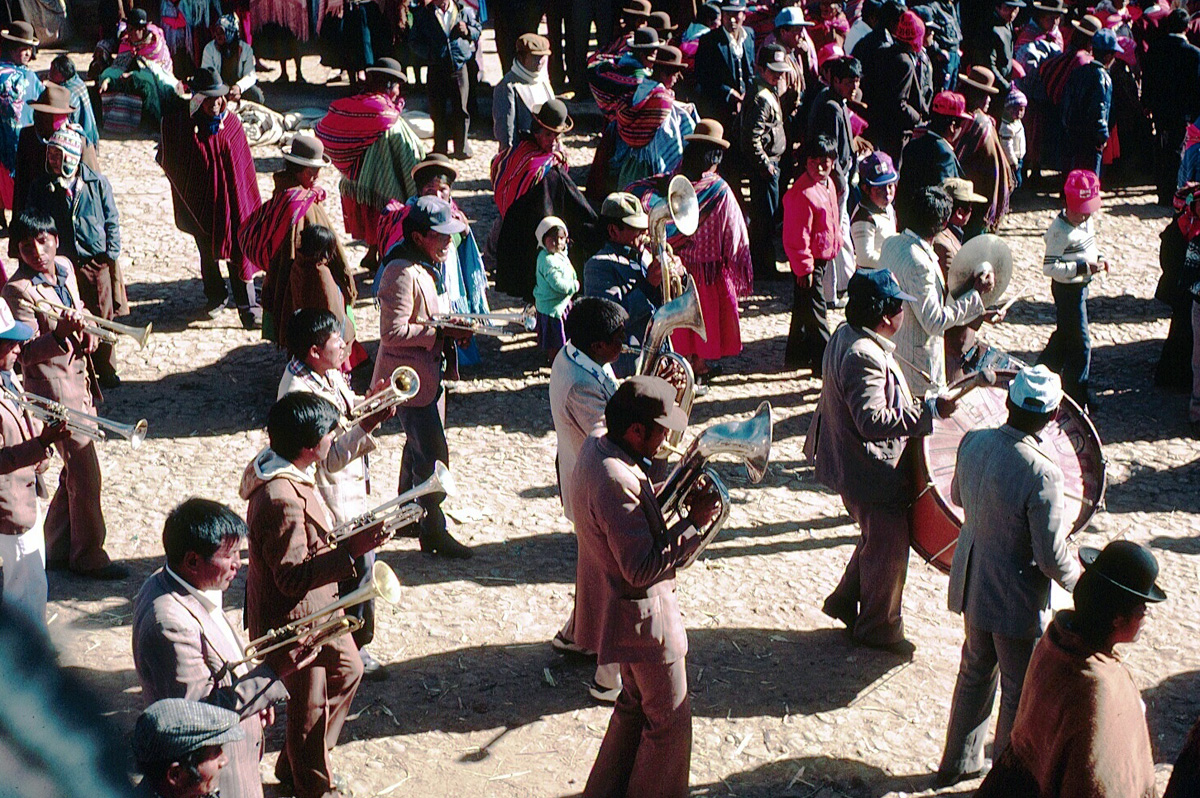
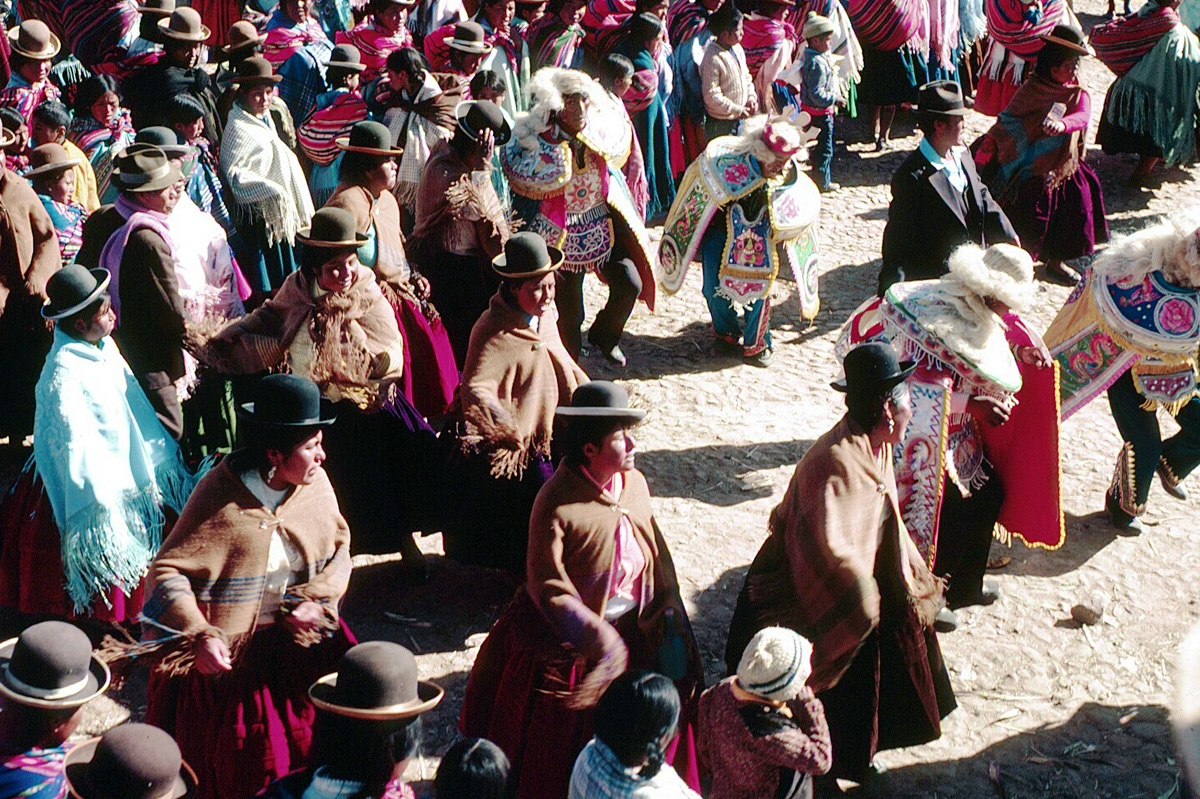
From around a corner of the square we could hear strains of clashing brass bands. Trumpets, French horns, tubas, big bass drums – band after band came parading in front of us, playing their own version of the same melancholy tune. Women in brown alpaca ponchos, scarlet velvet skirts, and black bowler hats, threw their heads back high, bobbed low, twisted this way and that, proudly displaying their steps. Snaking among the women and the bands were fantastic characters in cartoon armor, floppy cardboard capes with layer-cake shoulders, silly white, brown or orange wigs on their heads. A mocking affront to the conquistadores?
An hour and a half later, we began rumbling down the road toward Puerto Acosta.
Now, there is a superstition among the Indians of the region that whenever Easter Sunday comes too early, before the end of March, as had occurred this year, it is a fateful harbinger of natural calamity and disaster. True to form, rain after rain had deluged the area in previous weeks, raising the level of gigantic Lake Titicaca nearly ten feet. Entire villages had been inundated with water, farmlands had turned to mush, the train on the Peruvian side of the lake between Juliaca and Puno had discontinued service because most of its tracks were submerged and, of course, portions of road were completely flooded.
The impact on our journey was such that there were parts of the highway that were so under water that the weight of the passengers in the truck would cause the vehicle to bog down. We had to abandon the truck and scurry, sometimes as much as three quarters of a mile over steep inclines, to catch up to it, waiting with its engine revving. No one wanted to be left behind. Even with that precaution, water would rise to near the top of the truck’s four foot high wheels, so close to its underside that it looked as if it might float away. Somehow, it always managed, struggling sluggishly through the lake’s new periphery. We continued on.
At 7:00 that evening, we loped into Puerto Acosta. The place was utterly dark save for a lone dim streetlamp near the bus stop, the town’s only electrical extravagance. A small boy led Patrick, Josh, and me through the black streets to an unmarked pension whereupon a gaunt, jowl-faced Spaniard, flashlight in hand, greeted us at the door. He led us to a rectangular stone room, spartan but not unpleasant, where there was a bed for each of us. The room came to 2 million pesos apiece, extra for however many thin candles we burned. The bathroom was outside and around the corner: a sink, no shower, only cold water.
No matter, we were happy to be there. The Spaniard brought us a large beer to cool our thirst, and we queried him about getting to Italaque. To be sure, we could reach the pueblo from Puerto Acosta, he said. But there was no road and no transport, only a path. We could walk it easily, he claimed. The path, he said, was muy directo. And the village was only 25 kilometers away!
Next Week: Part Two: “El Condor Pasa”
Thanks to Martha Winneker for editorial assistance.
Text and photos Copyright Henry Kuntz. All Rights Reserved.
* Note:
While we were on a strict traveler’s allowance, we became instant millionaires upon entering the country. The Bolivian peso was trading at nearly two million (!) to one US dollar. The currency was so devalued that a single sheet of toilet paper was worth more than a one peso bill. Luckily for us, there were now one million peso notes. There were reports of restaurant patrons having to produce foot high stacks of bills to pay for a meal.


 George Cremaschi was born in New York City, and studied jazz at Jazzmobile in Harlem, composition at Greenwich House Music School in Greenwich Village, and improvisation at countless Downtown dives. Recent years have seen many performances and collaborations in the US and Europe with such renowned musicians as Evan Parker, Marshall Allen, Andrea Parkins, Gert-Jan Prins, Mats Gustafsson, Paul Lovens, Nels Cline and Saadet Türköz among others. As a composer, he has written nearly 100 pieces for chamber groups, small ensembles, solo contrabass, electronics, cinema, spoken word, dance and theater. He divides his time between Oakland and Tábor, Czech Republic, where he is an artist in residence, curator and administrator at Cesta, an international arts and cultural residency center.
 Tom Djll, born Indiana, 1957. Studied music at Berklee School of Music, the Colorado College, the Creative Music Studio, and Mills College with Anthony Braxton, Roscoe Mitchell, Karl Berger, Lester Bowie, Leo Smith, George Lewis, Pauline Oliveros, Alvin Curran, and many others. Tom has spent over twenty years (ab)using the trumpet as an analog flesh synthesizer. He has made a lifelong study of the art of improvised music, and has been performing since age seventeen. He has performed with Natsuki Tamura, Andrew Voigt, Biggi Vinkeloe, Chris Brown, Gianni Gebbia, Steve Adams, Fred Frith, and many many others. Tom Djll also writes about music for The Wire, Signal To Noise and other publications.
  Greg Goodman is one of America’s most distinguished improvising pianists. He is just as distinguished when he is in Europe. He was also very distinguished when he was in the Soviet Union in 1989, but it is still not clear whether or not Russia is part of Europe, or if it should be. This ordinarily would not affect Greg Goodman, or his distinguished career; at least, not in his opinion. For the purposes of this biography, Greg Goodman has worked with many of the world’s leading improvisers, including John Cage, Nicolas Slonimsky, and his Mother; he has also worked with many who did not lead. When not working, he is the proprietor of Woody Woodman’s Finger Palace, the San Francisco Bay Area’s longest running (since 1978) presenter of avant-garde music and theater. He also runs (from) the famous Beak Doctor Records. Currently, he is writing this sentence.
  Phillip Greenlief, since 1982, Saxophonist/Composer. He has performed internationally in a variety of settings. Greenlief’s recordings and performances have received critical acclaim in many national jazz publications (Down Beat, Jazz Times, 5/4, Cadence, Modern Saxophone, All About Jazz, The Los Angeles Times, etc.), as well as residing on many Critics Top 10 lists. His duo recordings of improvised music with bassist Trevor Dunn and drummer Scott Amendola received 5 stars in the 1999 Music Hound Jazz Essential Album Guide. Phillip is the founder of
  Cheryl Leonard. Glass shards and pinecones, glaciers, boxspring mattresses, a flock of accordions, circular saw blades, viola, the erhu, hyenas and whales and elk, Cheryl E. Leonard’s works explore subtle textures and intricacies in sounds not generally considered musical. These investigations often include the creation of instruments, primarily from found materials. She has been awarded residencies at the Djerassi Resident Artist Program, Engine 27, Villa Montalvo, and The Lab (with RK Corral), and has been honored in New Langton Art’s Bay Area Awards Show. Recordings of her music are available from Ubuibi, Great Hoary Marmot Music, Pax Recordings, Apraxia Records, 23 Five Inc, Old Gold Records and The Lab. In addition to her musical endeavours Leonard is a mountaineer, studies aikido and Chinese landscape painting, and collects pinecones with handles.
 Dan Plonsey is known as a composer, saxophonist, concert presenter and teacher of mathematics at Berkeley High School. He has written music for the Bang on a Can All-Stars, Toychestra & Fred Frith, Santa Cruz New Music Works and the Berkeley Symphony, but most of his music has been for his own ensembles, as documented on a dozen CDs. He has performed and recorded with Anthony Braxton, Eugene Chadbourne and Tom Waits, but more frequently with local greats John Schott, John Shiurba, Robert Horton and many others. Plonsey is currently at work on an opera, in collaboration with Harvey Pekar (of American Splendor fame.)
 Gino Robair is a percussionist, music journalist, and published composer living in the San Francisco Bay Area. Gino frequently tours North America and Europe as a soloist and often improvises in ad-hoc groups. He has performed and/or recorded with Anthony Braxton, Tom Waits, John Butcher, LaDonna Smith, Otomo Yoshihide, Eugene Chadbourne, John Zorn, Nina Hagen, Thinking Fellers Union Local 282, Myra Melford, ROVA Saxophone Quartet, The Club Foot Orchestra, and he is a founding member of the Splatter Trio.
  Damon Smith, born Damon Jesse Smith on oct. 17th, 1972 in Spokane, WA. Did “freestyle bmx” bicycle riding (a much more dangerous forshadow to “freestyle” music!) from age 13 to 23. Started music in 1991, under the influence of Mike Watt (Firehose & The Minutemen) on fender bass. Lead several punk/art rock combos until 1994. Upon receiving Peter Kowald’s landmark lp “Duos;Europa,” Damon sold the fender bass and concentrated solely on double bass and free music. Damon’s music is rooted in the tradition of “free jazz”, and has worked with many of the leading voices in that idiom, including Cecil Taylor, Peter Brötzmann, Frank Gratkowski and Joëlle Léandre.
  Kenneth Atchley is a sound, video, and installation artist who fashions and performs works ranging from pure-tone and noise hymns to distortion-studded, richly harmonic, electro-acoustic devotionals. Since 1997, his work has included the use of fountains as sound-sources, objects, environmental and metaphorical elements. His work continues to be informed by and abstract that work and study. Atchley’s music and installations have been featured in venues ranging from U.S. hardcore-noise dungeons and New York dance lofts, to art galleries and performance cellar circuits of Europe. Atchley’s CD of solo, electro-acoustic-noise works Fountains was released by Auscultare Research. His duet with John Bischoff has been released on Bischoff’s 23Five CD “Aperture”. profile of his work was included in the June, 2005 issue of The Wire (#256).
 Laetitia Sonami was born in France and settled in the United States in 1975 to pursue her interest in the emerging field of electronic music. Since 1991 she has developed and adapted new gestural controllers to musical performance and composed works with these materials. Her unique instrument, the lady’s glove , is made out of black lycra and is embedded with sensors which track the slightest motion of each finger, the hand and the arm. The performance thus becomes a small dance where the movements shape the music. he has been performing in numerous festivals across the United States, Canada, Europe and Japan, among which the Ars Electronica Festival in Linz, the Bourges Music Festival in France, the Sonambiente Festival in Berlin, and the Interlink festival in Japan. She lives in Oakland, California and is currently guest lecturer at the San Francisco Art Institute, and Milton Avery Summer program at Bard college.