Michael Tenzer | Let Others Name You

Michael Tenzer

Let Others Name You (New World Records 80697)

Genta Buana Sari and Sanggar Çudamani Gamelan Collectives; Vancouver Players (Nonet); Naoko Christ-Kato, piano; OSSIA Ensemble, David Jacobs: conductor. Recorded: Unstable Center June 19, 2003 Pengosekan, Bali; Underleaf July 9, 2006 Pengosekan, Bali; Resolution October 25, 2008 Rochester, New York; Invention and Etude February 22, 2005 Lubeck, Germany.

In June 2003, I was fortunate to be in Denpasar, Bali for the premiere of American composer Michael Tenzer’s piece Unstable Center for two gamelan samaradana orchestras. I wrote of the performance in my Report from Bali 2003.

But Unstable Center was only the first part of a triptych. Now it, along with the triptych’s second and third parts – Underleaf (from 2006) and Resolution (from 2007) – can be heard in beautifully detailed recordings on Michael Tenzer’s new CD, Let Others Name You.

Unstable Center (whose Indonesian title Puser Belah translates as “split navel”) was written as a response to the Bali bombings of October 12, 2002. It asks whether it is possible to bridge the gaps between inherently different cultures and values.

The genius of Unstable Center is that it is a programmatic work rooted in purely musical advances which serve in turn to further its programmatic ends.

The samaradana orchestra which the piece employs is a relatively new type of gamelan that was developed in the 1980s by I Wayan Berata. With seven tones instead of the usual five – most Balinese music is pentatonic in nature – it can be adapted to play a variety of Balinese music. Recently, new pieces have been composed specifically for the semaradana gamelan that propose a more structurally open, multi-pentatonic, multi-modal music.

Unstable Center takes these new concepts as a given and adds another orchestra. Somewhere in the middle of the piece (and in Underleaf and Resolution as well), complex South Indian rhythmic figures and patterns are woven into the mix.

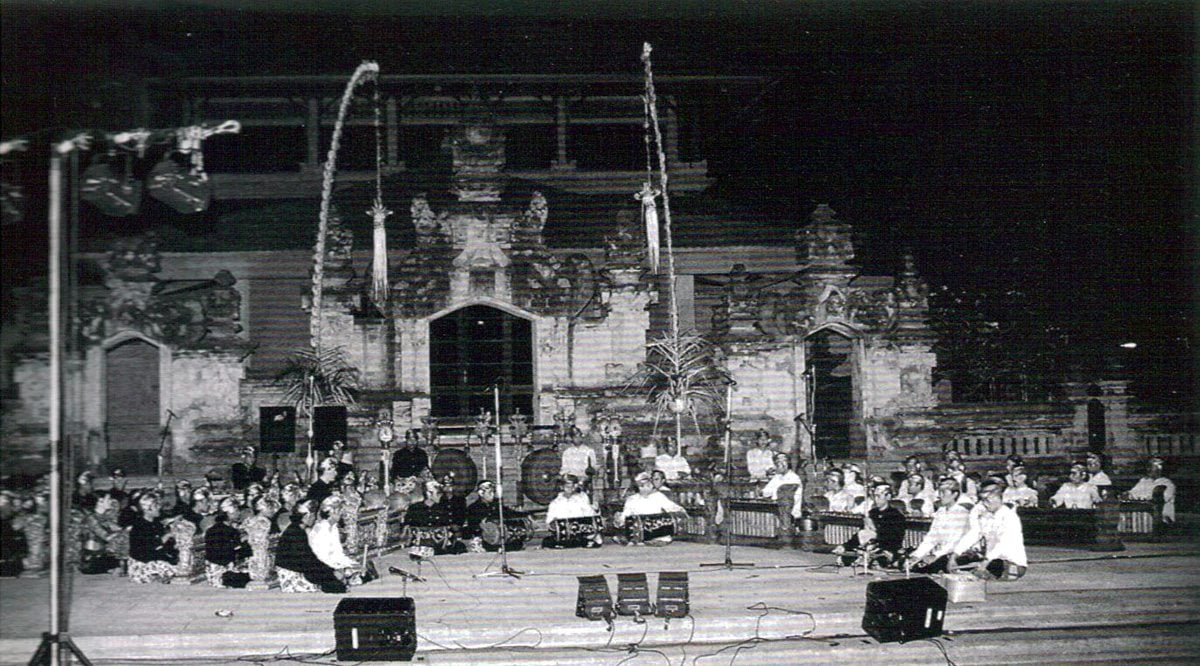
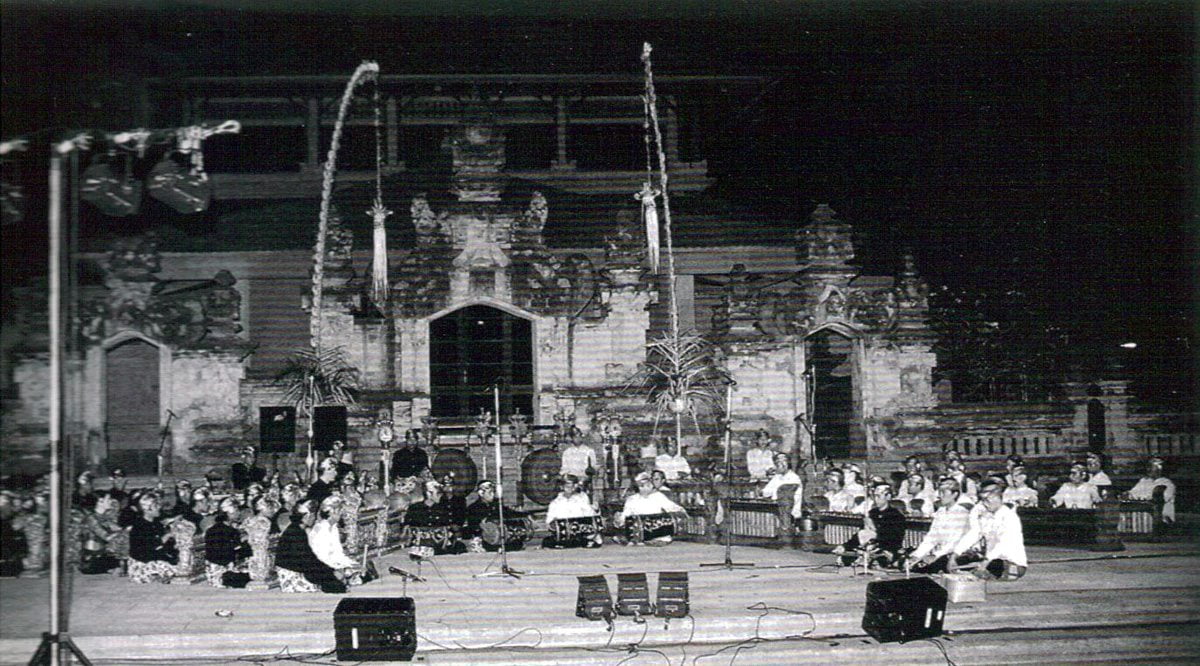
Programmatically, Unstable Center has to do with a first-time meeting between two isolated cultures, each one represented by one of the two gamelan orchestras. In performance, the orchestras faced each other across an open air stage.

The piece begins primordially, as if at the beginning of time. Each orchestra plays in its own musical universe. One plays more quietly, the other more demonstrably loud and assertive. With gradual awareness of the other, there are points of musical conflict and cooperation. There are any number of textural twists, marvelous sudden rhythmic interjections and shifts in dynamics until, at the piece’s center, a powerful yet slightly uneasy unanimity is achieved between the two bodies. It lasts only briefly. Gradually, the heady communion comes apart, each orchestra retreating into its own parameters, then finally retiring to musical spaces that mirror the opening.

In performance, there were some subtle, yet important, visual components to the work as well. In the middle of the piece, one of the two drummers from each orchestra exchanged drums, symbolic of creating a cultural bridge between the groups. And at the work’s conclusion, each of the players of the large gongs from each orchestra abandoned their posts at the rear of the stage and walked to the front. As the large gong is more or less the anchor of any gamelan ensemble, I took the musicians leaving their instruments to indicate that while the piece was finished, the process itself was unfinished; unfinished because it is an ongoing one and must be continually, freshly re-engaged in.

This leads us to Underleaf, the title of which is taken from a Balinese children’s song which suggests that one can’t simply sweep away cultural differences. They remain where they are, “underleaf.”

For Underleaf , we again have two orchestras. One is a Balinese gamelan semardana, but the other is a jazz-infused nonet with 2 clarinets, 2 saxophones, 2 trumpets, 2 trombones, and electric piano. For this piece, however, the two orchestras do not face each other; each is embedded as a complete and separate entity within the other ensemble.

Underleaf seems to be asking how two fully developed, dynamically self-contained cultural bodies can get along in close proximity.

Musically, the answer seems to be for them to each go their separate but equal ways, interacting for only an occasional gratuitous amenity. What’s interesting, however, is that Underleaf provides an additional if perhaps unintended answer to the question it poses. For as one becomes accustomed to hearing the piece, its built-in harmonic and rhythmic clashes begin to dissolve and fade. The ear begins to perceive a new musical/cultural unity. This, in a sense, is how real cultures evolve, shift, and form new wholes. People subconsciously begin to incorporate and eventually build upon new (if at times contradictory) cultural input.

Resolution, which follows, suggests even more. The piece employs a full classical orchestra and two Balinese drummers. While at first glance, the balance between the two cultural entities would seem to be unequal, we realize on reflection that each represents the essence of musical expression of the two cultures. In the west, it is the classical orchestra which carries cultural weight, whereas in Bali it is the drummers who are the leaders of the gamelan, the ones who direct and dynamically shape the music as it goes along.

Michael Tenzer describes Resolution as a “recessional,” a piece that would ordinarily be played as an audience exits a performance. As such, it both summarizes and re-capitulates what the audience has experienced, moving it out of performance time and space into real world time and space.

Building on the strength of an extensive string section, Resolution has a dreamlike, near fantasia quality to it that rises above its own inner drama to virtually hover over the first parts of the triptych. The ease of interaction between the western orchestra and the Balinese drummers suggests to us that real world problems of cultural interaction are best solved by each of us recalling the spiritual essence of who we are as human beings. While no music can solve hardcore problems of a geo-political or economic nature – most often the basis of broader cultural disputes – it can offer us, as Resolution does, the spiritual strength to confront and solve those problems.

As a recessional, Resolution suggests as well that this is an ongoing process. There can be no final resolution, only an ongoing will to resolve that must be continually refreshed and renewed in our own psyches.

Let Others Name You also contains two short solo piano pieces by Michael Tenzer, Etude and Invention (from 2004) which are rhythmic-harmonic “studies” for the final parts of the triptych. They are stunningly and passionately played by Japanese pianist Naoko Christ-Kato.

Henry Kuntz (October 2009)

More on Let Others Name You can be found on the New World Records web page by clicking here… and on Michael Tenzer’s web page here…

Report from Bali 2003

Report from Bali 2003

(Updated 2009 with New Information, Photos, and Links)

I wanted to share with you some of the music and music-related events I encountered on my recent trip to Bali, where I spent most of the month of June.

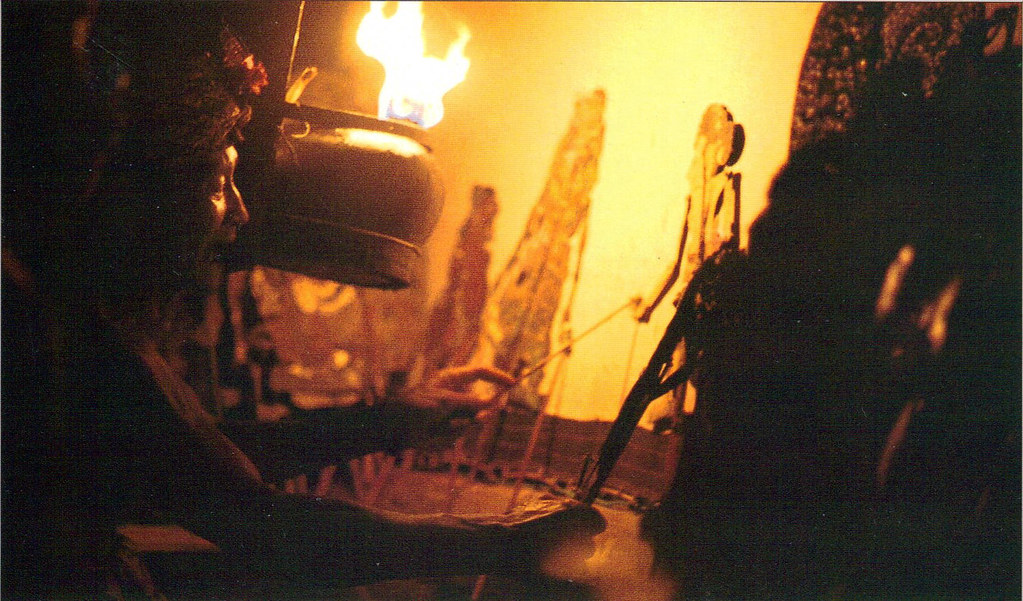
One of the archetypes I’ve used to prepare for and to engage in improvisation is that of the Indonesian shadow play (wayang kulit); or more specifically, the archetype of the shadow puppet master or dalang.

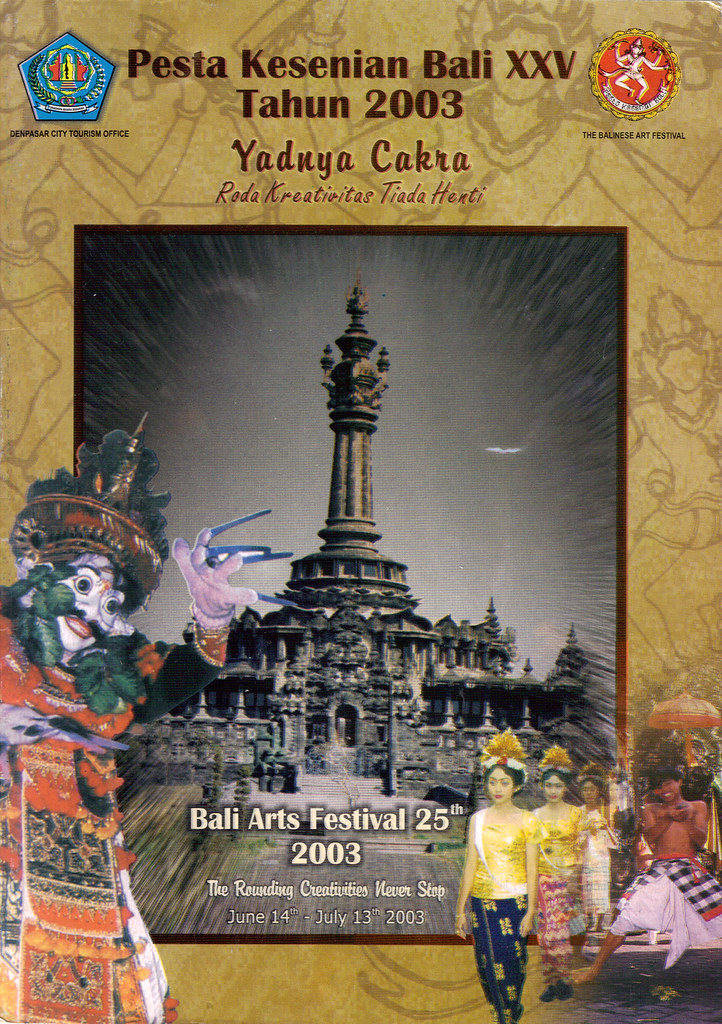
So I was excited to note that Bali’s 25th Annual Arts Festival (which began on June 14 in Denpasar), a month-long series of music, dance and arts/crafts presentations, was to feature shadow play performances by masters of the art from various regions of the island.

While we use the term “master” rather loosely these days to refer to almost anyone who has attained a certain degree of skill in their chosen profession, the dalang is a master in a much broader sense. He must undergo rigorous training in a number of fields (music, literature, dance, drama) and is more like a secular priest than a mere performer. Indeed, the ritual allowing one to begin working as a dalang is closely akin to the ordination of a Hindu priest. (Note: While women priests are common in Bali, I was unaware in 2003 of any women working in wayang. However, women shadow puppet masters were prominently featured in a subsequent Bali Arts Festival.) Further, the dalang is thought of as a type of spiritual medium, one who in the performance of his art, opens lines of communication between the natural and supernatural worlds. He bridges the gap between those worlds and allows the unseen forces to speak through him. As such, although the plays themselves are almost always based on traditional and well known stories, they are typically laced with current social and political commentary, often couched in humorous terms.

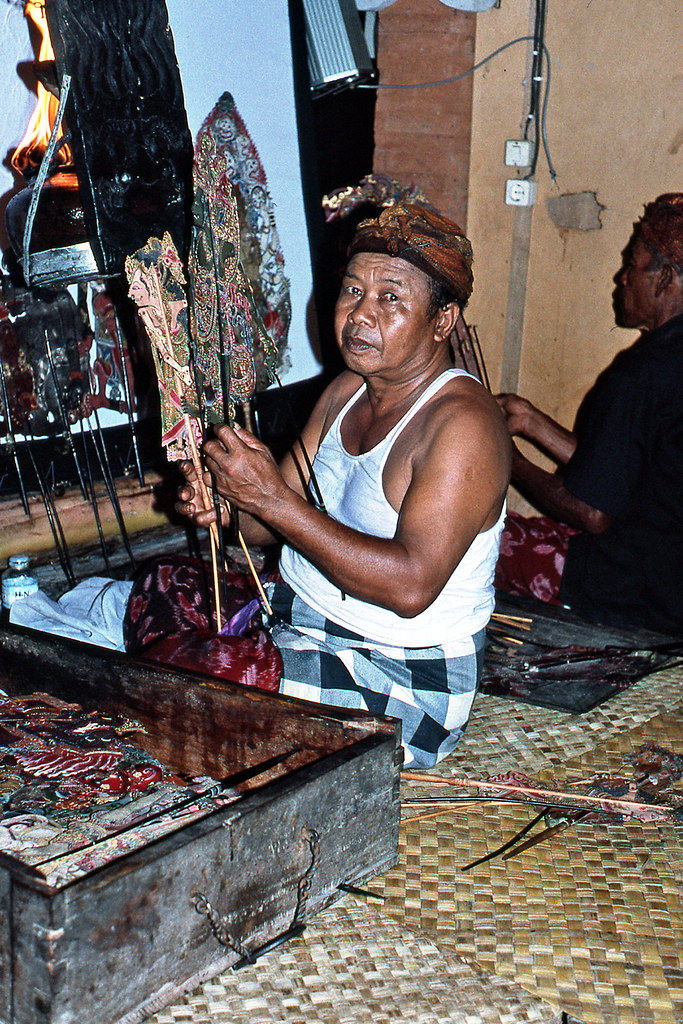
The plays are presented on a 6 by 4 foot screen behind which is a hanging oil lamp which projects the flickering shadows of the leather puppets. There may be as many as 125 for possible use. The dalang sits behind the lamp which also has a microphone attached to it into which he speaks. He must be conversant in at least three languages: old Javanese (or Kawi), the language in which the plays transpire, and Balinese and Indonesian, the languages which the four clown-servants of the main (both good and bad) characters speak to translate and comment upon the proceedings for the audience, almost none of whom understand the old language. Additionally, he must speak in any number of voices, often switching between them in rapid succession, as it is he who speaks for each of the puppets. At the same time, he is manipulating and/or moving the puppets through space in an appropriate manner.

Between the toes of one foot, he holds a wooden knob with which he strikes the box which holds the puppets when not in use, in this way directing the gamelan ensemble accompanying the play and adding dramatic emphasis to scenes with his rhythmic knocking.

There is also always a battle somewhere in the play between the forces of good and evil. While the “good” always wins, it is not a triumph in any ultimate sense, only a single moment wherein which the two forces are kept in some sort of balance which allows the world to remain in harmony. While these battles take place in the “physical” realm, I was told a few years ago in Java, when I attended a wayang performance there, that the reason the good characters always triumph is that they have great “inner” strength, unlike the bad characters who only “appear” to be strong, acting blustery and throwing their weight around.

Parallels for improvisation exist in the way in which the free improviser moves between known and unknown worlds, allowing unconscious and subconscious realities to come into play; allowing different, perhaps seemingly mutually, exclusive voices to emerge. Also, as I’ve written elsewhere, I see the improviser as fulfilling a type of shamanic function, forging sound realities which may exist as archetypes for the manner in which we would like to shape our world. We may also use sound therapeutically in this way, as part of both a personal and social cultural context, allowing “good” and “bad” forces to play out in the sound world in such a way — perhaps even with some levity — that a respectful balance of same is achieved both within and around us.

It is worth noting too the spiritual preparation the dalang makes prior to performances, asking for protection from evil forces, some of which he will bring into being through the puppets. He asks also that the “gods” may speak through him in the performance and that the audience will take delight in his work — which I take to mean that the audience will be delighted in their inherent recognition of the archetypical realities presented in the play. Purification rites follow the performance as well.

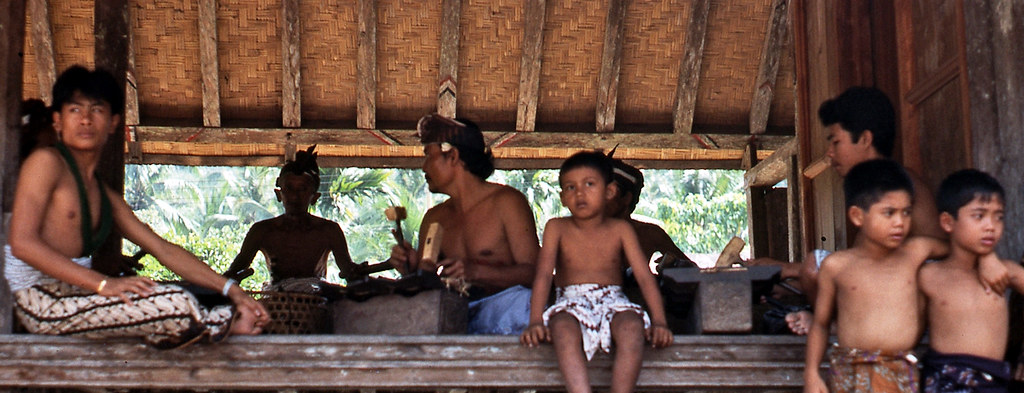
The performances I saw, four in all, differed in the types of orchestras employed to accompany the plays, the level of involvement of the music with them, and the styles of working of the different dalangs. The performance from east Bali (Karangasem) and that from central Bali (Bangli) were similar in that the accompanying ensembles were more of a “standard” sort, four players of gamelan gender, 2 pairs of 10-keyed metalaphones tuned an octave apart in a 5-toned roughly equidistant (slendro) scale. (The players play the instruments two-handed with round-headed wooden hammers, continually damping the keys with the palms of their hands as they go. Lower-pitched unison lines are often played with the left hand while decorative lines of varying complexity are added with the right.) The ensemble from west Bali (Jembrana) used similar instrumentation but with the addition of small gongs, cymbals (ceng-ceng), and an oblong two-headed drum (kendang). This type of ensemble is considerably more dramatic in effect and is used to accompany, among other things, tales from the Ramayana, typically those which include a fair amount of conflict. In this instance, however, it seemed to be almost “tongue-in-cheek” as, following a particularly auspicious and portentous opening, the dalang engaged his audience with more than an accustomed amount of humor.

By far the most ambitious production I saw was from the village of Sukawati, Gianyar (central Bali), a village with an island-wide reputation for the excellence of its dalangs. This shadow performance featured a quite large ensemble, some 20 musicians playing instruments of an ancient orchestra, the seven-tone gamelan selunding, whose keys are made of small to large iron slabs (most Balinese gamelan instruments have bronze keys) suspended over wooden trough resonators (as opposed to the individual-key bamboo resonators more commonly in use). The keys are struck with large wooden hammers; like the gamelan gender, the instruments are played two-handed.

Included in the orchestra were four players of bamboo flutes (suling) who doubled at times on conch shells, adding subtle low tones to the sound of the ensemble. Also featured were two drummers (of the oblong kendang) and players of large and small gongs and of cymbals (ceng-ceng). Even for this orchestra, only rarely heard in its villages of origin in east Bali (once a year in most locales), the addition of flutes, drums and gongs to the basic ensemble was extremely unusual.

The music itself was wild! The flutes blew long, wavering on-and-off tones, continuously played, the results of circular breath. The drums interjected thunderous rhythms while the clanging, clattering sounds of iron moved in, around and about in textural circles and rose and fell in smaller and larger percussive waves. A preliminary piece, such as is normally played prior to the beginning of the wayang itself, actually drew applause from an overwhelmingly Balinese audience, the first time I’ve heard such a thing in this context. As is the case in all wayang performances, at times the gamelan only served to highlight and forward the action of the play. But even this was quite extraordinary. And then, when somewhere in the middle of the performance, the orchestra members put aside their instruments to vocally interject strains of “ketchak” (the now internationally well-known “monkey chant”), the audience howled with delight and once again broke into applause. This ensemble’s music was also the most integrally woven with the action of the play of any of the performances I saw.

The stories themselves, which I had to rely on others to relate to me, varied also. The first, presented by an elder dalang from east Bali, was somewhat out of character in that there were no “good” and “evil” forces in the strict sense. Rather, the story concerned the coming to Bali of Hinduism and the resultant strife that ensued between Hindus and Buddhists over the truth of their respective religions. Eventually, however — through constructive interactions — each came to view the other with tolerance and respect. The dalang related the story in a fairly “serious” manner and with an enormous amount of engagement. When the play was finished, after about an hour and a half, he was in a heavy sweat and appeared to be in an altered state. He reminded me of seeing Cecil Taylor coming off stage after an hour or so of intensely pursued piano improvisations.

I never did get a sense of the plot in the obviously humorous tale presented by the dalang from Jembrana, the west. My driver and informant, who hailed from there, while admitting that the dalang was very funny (he himself was laughing throughout), felt the performance was “out of place” in the context of the Arts Festival. I think he was pretty much alone in this feeling, but he did not want to tell me too much about the story. I personally liked the dalang who, I felt, was extremely conscientious in his approach and, through his extensive use of humor, was attempting to blend old stories with new and to make old but universal messages meaningful to a modern audience.

Speaking of which, there was another more or less popular and “famous” dalang, Cenk Blonk, from Tabanan in the near west of Bali, who appeared in the festival but who I did not get a chance to see. He is well known for his manner of introducing modern characters into his plays. In his performance during the festival, I was told that he premiered a puppet of Amrozi, the “smiling” Bali bomber, as one of the evil protagonists! (Note: I’ve subsequently discovered that “Cenk Blonk” is not a person but a descriptive term for a new type of wayang from Tabanan. Wayang Cenk Blonk, geared to a younger audience, is more directly humorous and entertaining than traditional wayang. Modern instruments are used as well as ones from different Balinese ensembles, and contemporary sound and lighting are employed.)

The Bangli and Sukawati tales were similar in form, each with sections which included a fair amount of dialog. The Sukawati story told of the formation of Indonesia itself; I’m not entirely certain about the Bangli tale. There could not have been a greater contrast, however, between the two dalangs, both relatively young men (early 30s?). The Bangli dalang incorporated the gamelan, I felt, to least possible advantage. He also maintained a more taut and monophonic tone throughout. Uniquely, however, he often sang passages of the text, song-like rather than — as is more usually the case — rising-and-falling chant-like, and he at times used his tapping of the knob to create simple, drum-like rhythms.

The Sukawati dalang, on the other hand, was almost certainly the most sophisticated of any of these wayang masters. He only slowly brought his figures onto the screen. They appeared as flickering ghosts, materializing from nothing. His sense of drama was so great that I frequently felt on the edge of my seat, even while my actual understanding of the play’s content was negligible. It was rather like entering a movie theatre in the middle of a great film you know little about but immediately recognizing the style of it as masterful.

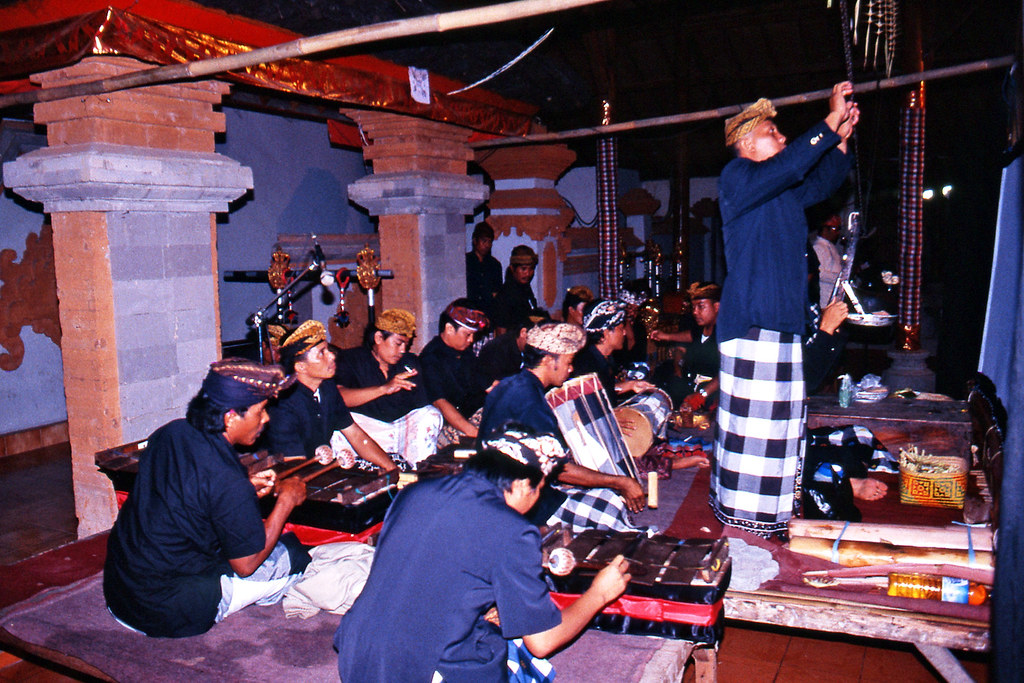
I attended one other festival program of great interest which featured as its main work a new piece for double gamelan orchestra (two gamelan semaradana from the village of Pengosekan in central Bali, played by members of the Cudamani Arts Collective (http://www.cudamani.org/) and six members of the Vancouver gamelan group Gita Asmara (http://www.gitaasmara.ca/Gamelan_Gita_Asmara/About.html) by the American composer and Bali music scholar (now living in Vancouver) Michael Tenzer. The overall program featured mixed works for Balinese and western instruments and included a handful of players both from California’s Gamelan Sekar Jaya (http://gsj.org/) (of which Tenzer was an original founder) and Canada’s Gita Asmara. The Sekar Jaya members worked with Balinese composer I Nyoman Windha to premiere a new work, Jaya Baya (translated as “Victory over Tragedy”), which featured trumpet, clarinet, guitar, violin, tablas, and a small (four-tone angklung) gamelan ensemble. It was an ultimately optimistic piece, with much feeling and pathos.

Without question, however, Michael Tenzer’s new work was “the event” of the evening. To understand its context, some background is in order. While nearly all Balinese music is based on pentatonic scales and nearly all large, modern (kebyar) ensembles contain only a single (multiple octave) scale of that sort, in the 1980s a new hybrid gamelan of seven tones (the gamelan semaradana) was created so that various types of Balinese music might be played on a single set of instruments. The idea was to be able to use the gamelan for fast, kebyar-type music (this music is normally played single-handed, one’s free hand being used to damp the keys, allowing the players great speed to create rapid-fire, interlocking rhythms) but also to have the capability of playing older, more elevated court styles as well. Until recently, that’s the way the semaradana gamelan was approached.

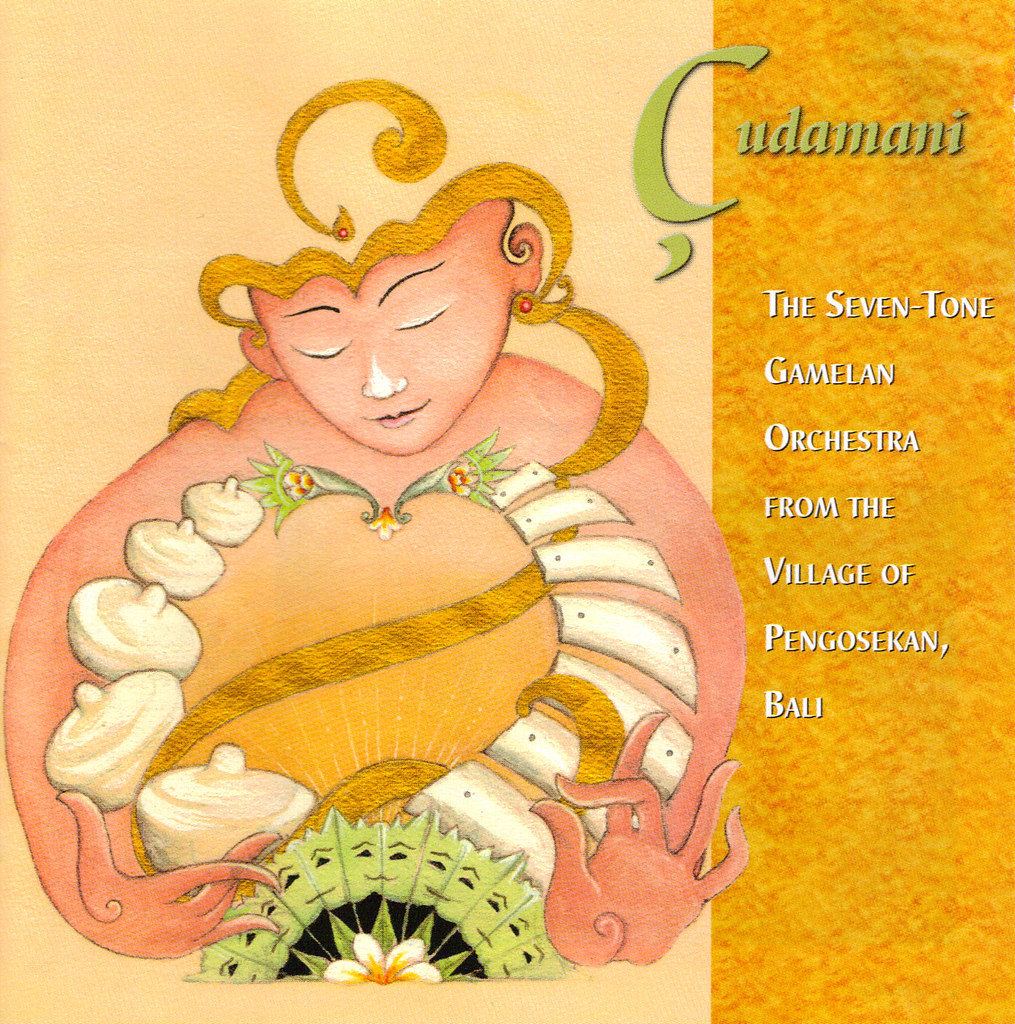
Then, only three years ago (in the context of engaging Gamelan Sekar Jaya in a type of “battle of the bands”), a work was created by Cudamani in Pengosekan, Geregel (also performed as a part of this program), which for the first time proposed a multi-pentatonic, multi-modal style of Balinese music. The piece included structural innovations as well, unusual silences and a broad dramatic sense not entirely common in Balinese music; to oversimplify, a sense of drama as much between as embedded within the lines. (The work has been documented on Wayne Vitale’s Vital Records on an excellently recorded CD entitled Cudamani: The Seven-Tone Gamelan Orchestra from the Village of Pengosekan, Bali (http://www.vitalrecords.ws/). The extensive program notes by Wayne are an education as well.

So Michael Tenzer’s piece took off from this new structurally open, multi-pentatonic, multi-modal perspective, upping the musical ante both in the piece’s ambition and by throwing in another whole orchestra. The work, Puser Belah or “Unstable Center,” was programmatic in nature, but its nature was such that it served to further the musical advancement. That is, it had to do with a first-time meeting between two entirely different cultures, each one represented by one of the two orchestras which faced each other across an open-air stage. As the piece commenced, each orchestra began playing entirely in its own musical universe, paying little if any attention to what was transpiring across the way from it. Additionally, the orchestra on the left began by playing extremely quietly while the orchestra on the right was more demonstrably loud and assertive. There were any number of textural twists, some marvelous sudden rhythmic interjections and shifts in dynamics until finally, at the piece’s center, a powerful yet slightly uneasy unanimity was achieved between the two bodies. The collective power of it was exhilarating, yet it lasted only briefly. Gradually, the heady communion began to come apart, each orchestra retreating into its own parameters, then finally retiring to musical spaces which mirrored the opening.

There were some subtle, yet important, visual components to the work as well. For example, in the middle of the piece, one of the two drummers from each orchestra exchanged drums, symbolic of creating a cultural bridge between the groups. Also, at the work’s conclusion, each of the players of the large gongs from each orchestra abandoned their posts at the rear of the stage and walked to the front. As the large gong is more or less the anchor of any gamelan ensemble, I took the musicians leaving their instruments to indicate that while the piece was finished, the process itself was unfinished; unfinished because it is an ongoing one and must be continually, freshly re-engaged in. (Note: on Michael Tenzer’s website (http://www.michaeltenzer.com/works.html), we subsequently learn that this piece was only the first of a triptych: the second piece Buk Katah or “Underleaf” for gamelan semaradana and 10-piece chamber ensemble was premiered in Bali in 2006; the third Tabuh Gari or “Resolution” for small orchestra and Balinese percussion was premiered in Toronto, Canada in February 2008.

In all, it was a relatively short piece, no longer than 15 minutes; but there was an opportunity to hear it played twice, both at the beginning of the evening and again at the end.

Marvelous on its own terms, this piece was also personally interesting to me in its implications for improvisation. Cultural relations, after all, while steeped in social identities, are nothing more than personal relations played out on a larger scale. That said, the main thing that has always interested me about group improvisation is how much musical independence or sense of true self individuals might maintain while (equally) contributing to and upholding a group identity. The prevalence among improvisers, I often feel, is that they are either reluctant to allow their full selves to come forth; or else they are assertive to the point of overshadowing the contributions of the other players. So did this piece suggest any answers? What it mainly suggested, it would seem, is the difficulty of maintaining that precarious and delicate balance between the individual and the group. It likewise suggested to me that, despite the elusiveness of means to an ultimately unified end, an honest process itself (of improvisation) may be just as worthy as any final “result” that is achieved.

Henry Kuntz, July 2003 (Updated April 2009). All Rights Reserved.

Certain background material for this report came from the online article Wayang Kulit: Shadow Puppet Performances http://www.murnis.com/culture/articlewayangkulit.htm at Murni’s Website http://www.murnis.com/index.htm; also from Wayne Vitale’s notes to Cudamani: The Seven-Tone Gamelan Orchestra from the Village of Pengosekan, Bali (Vital Records 440 http://www.vitalrecords.ws/).

Music and Ritual of the Modern Maya

MUSIC AND RITUAL OF THE MODERN MAYA

Introduction

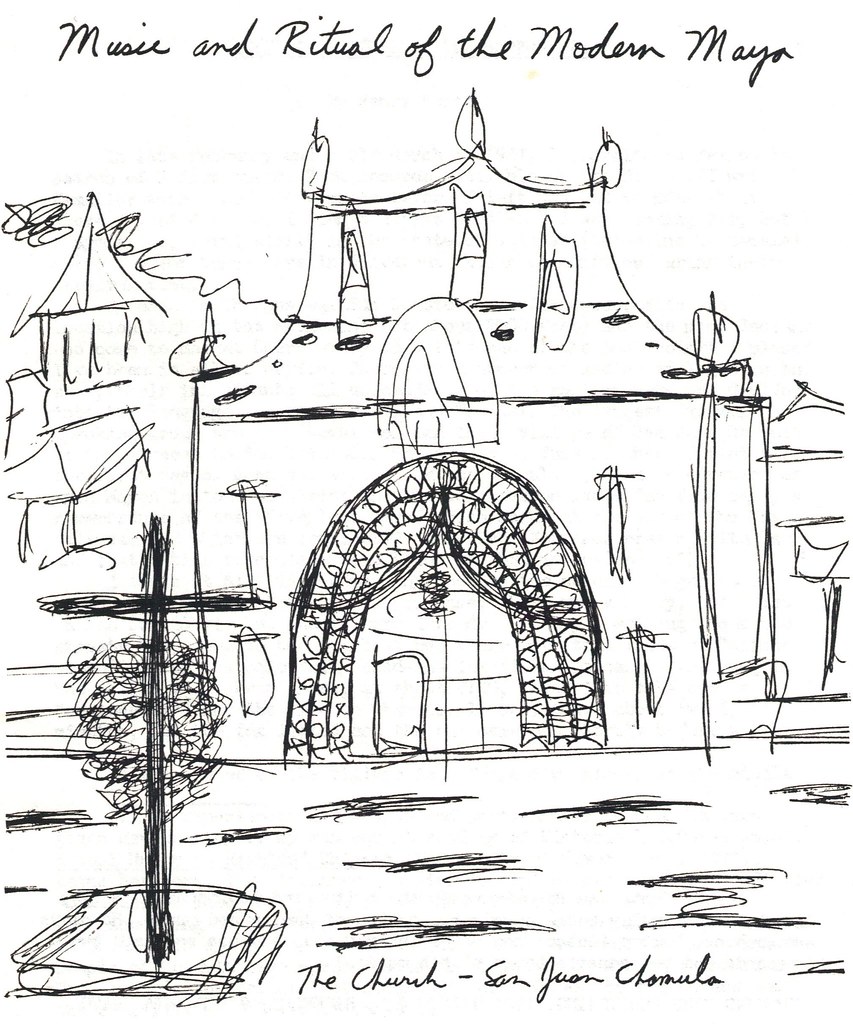
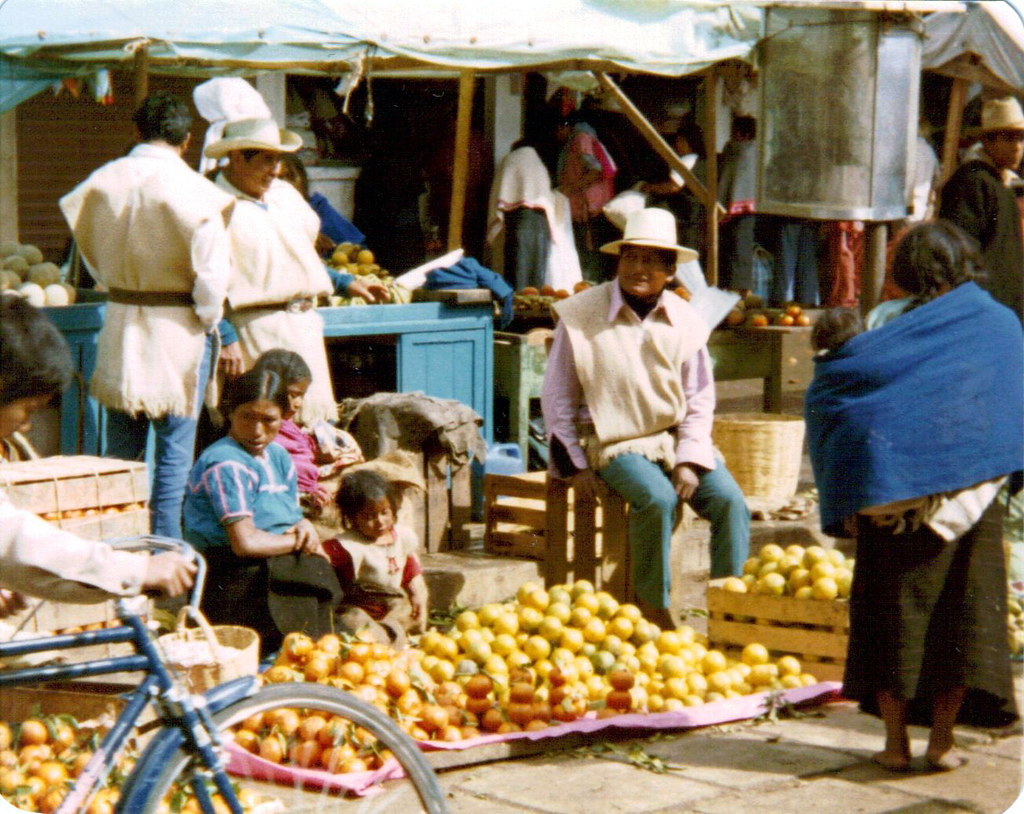
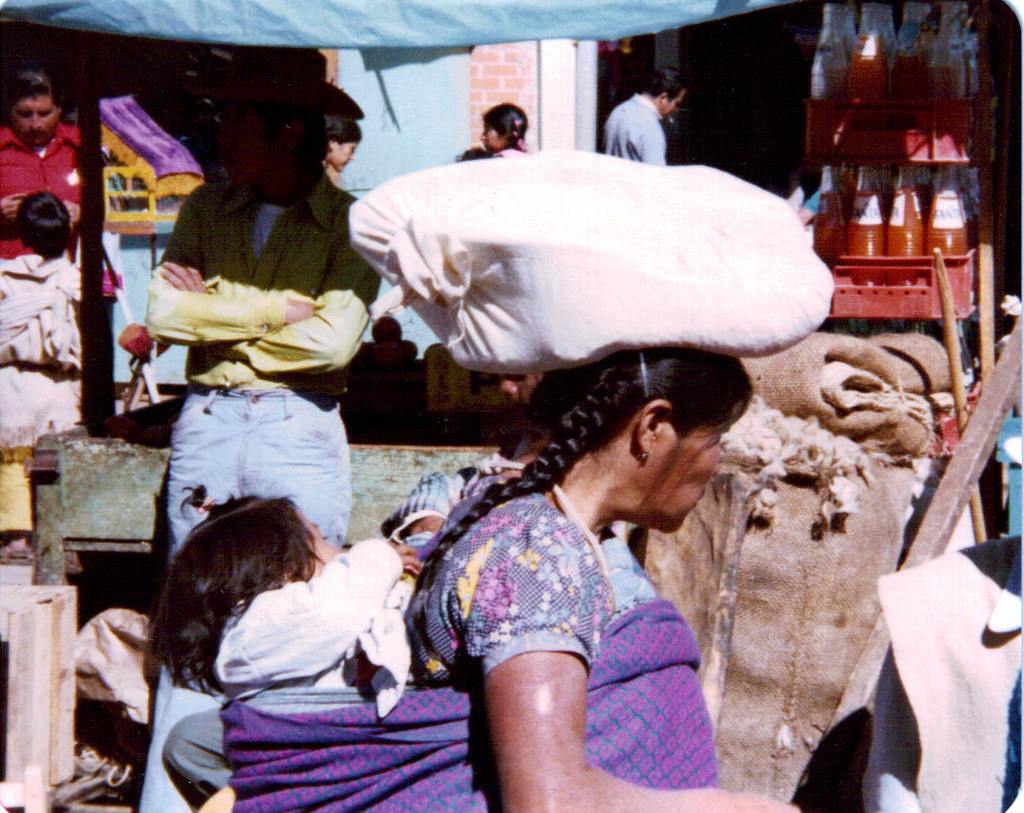
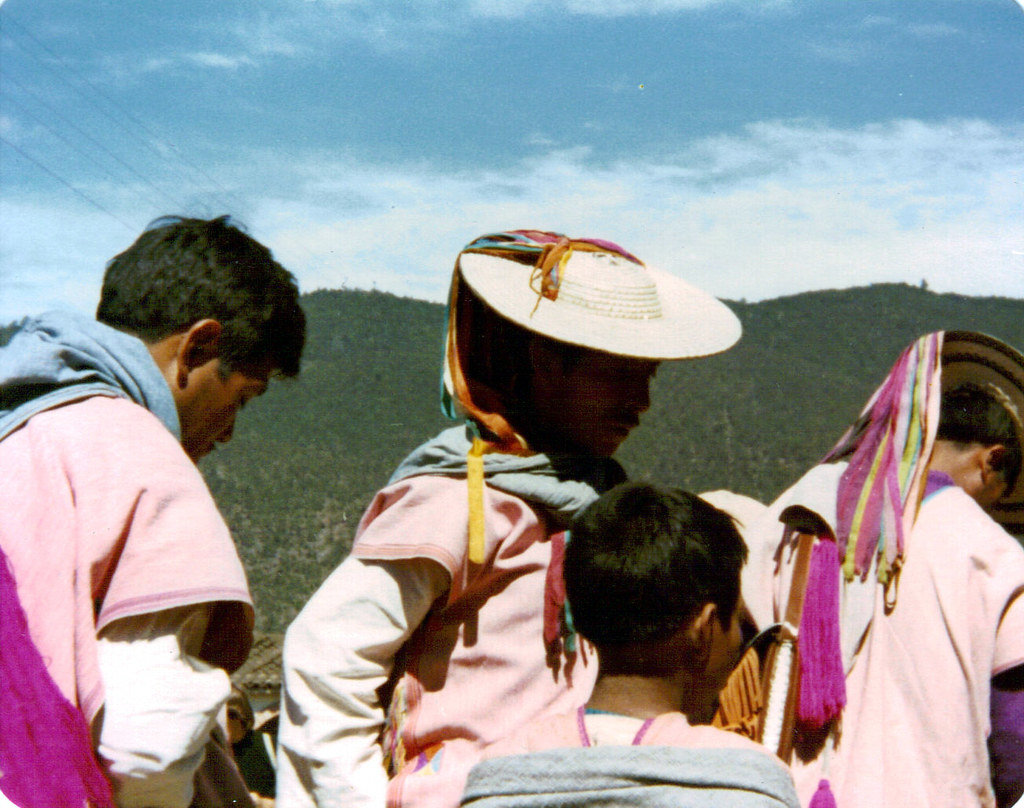
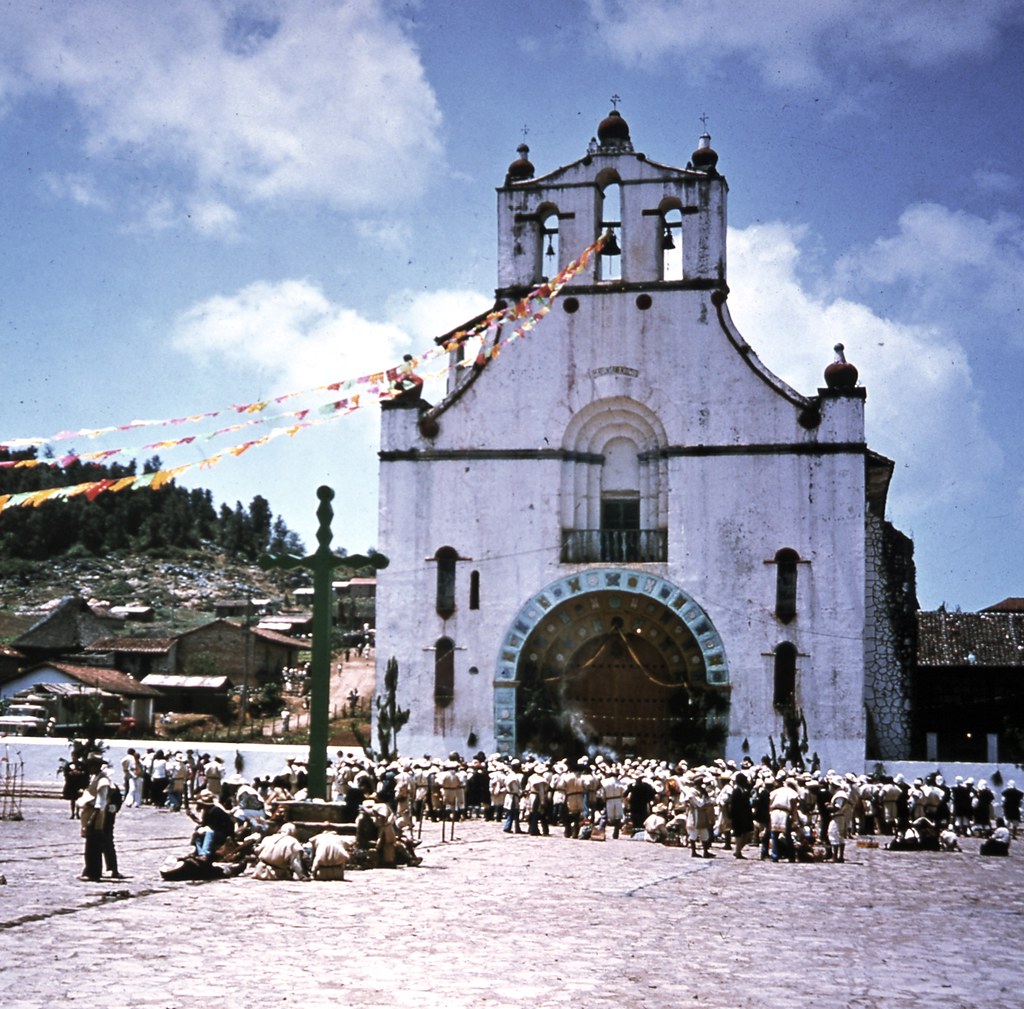
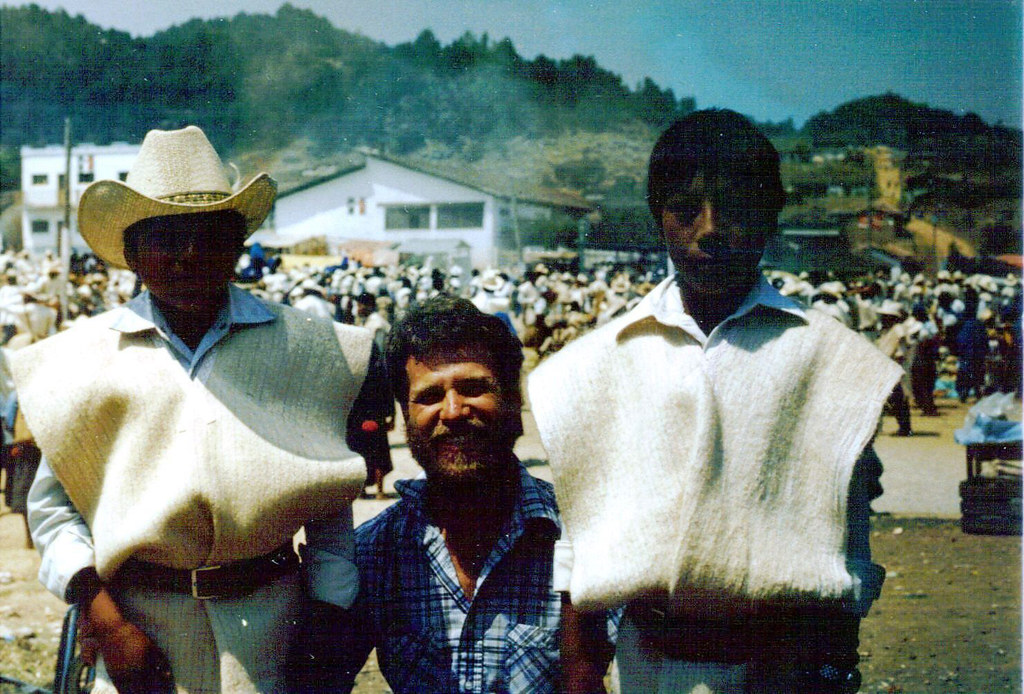
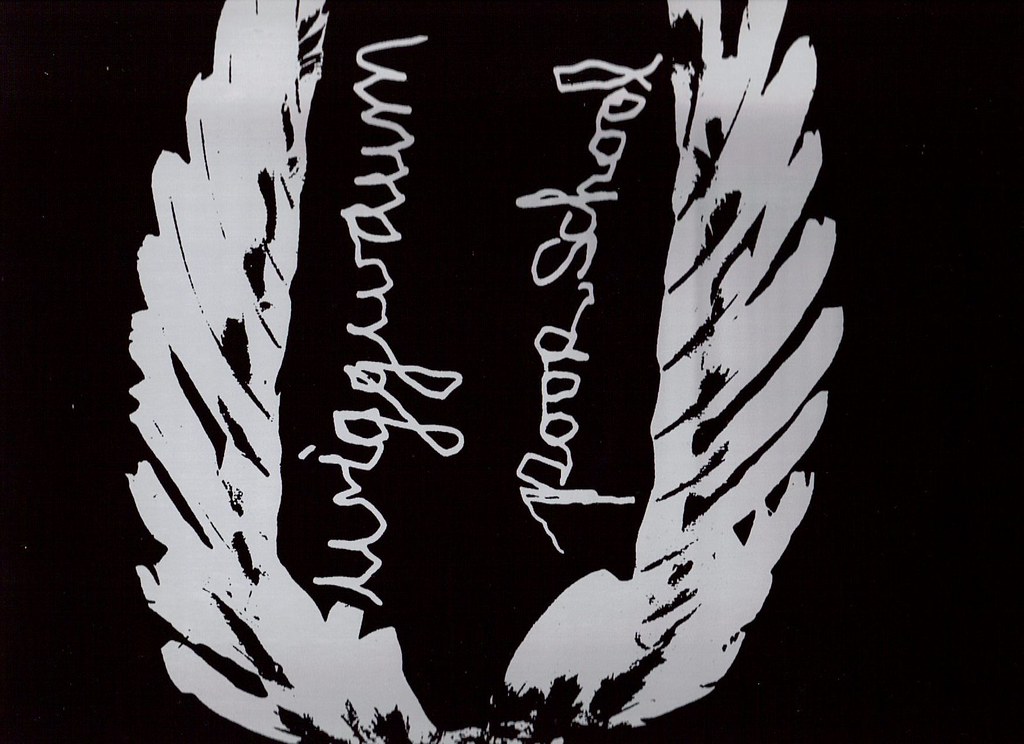
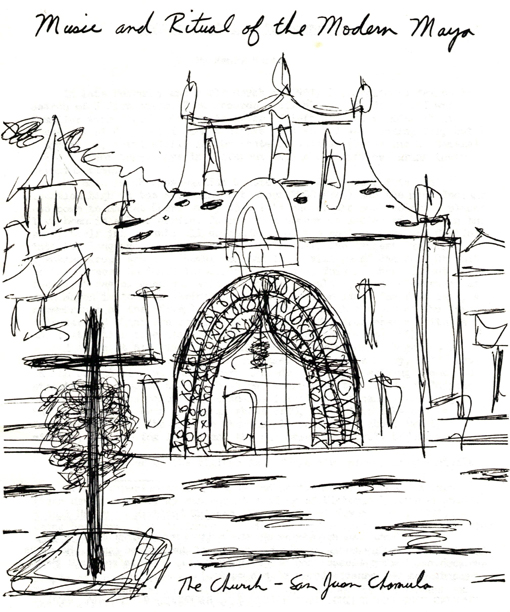
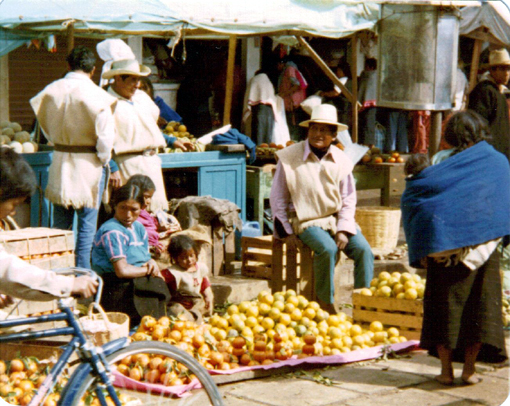
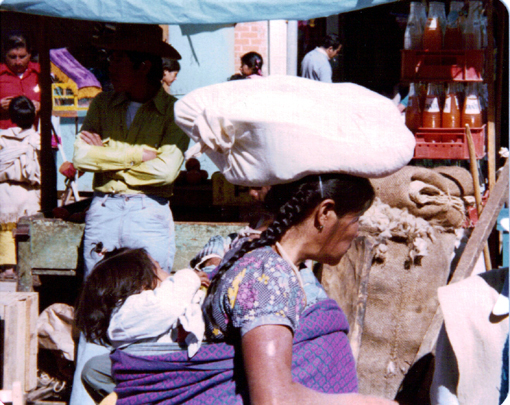
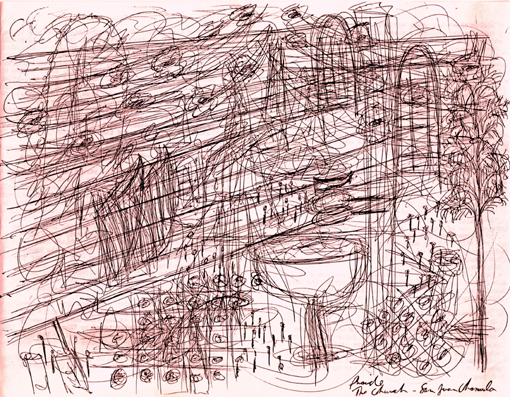
This piece was first published as a 20-page pamphlet in 1981. It included my drawings of the rituals and events described. This is the first time photos of any events appear along with the text. Because the Tzotzil Maya of San Juan Chamula strictly forbid photographing their rituals, I purchased photos of ceremonial images from Chamula years later in San Cristóbal de las Casas. Who the photographer was or when the photos were taken is a mystery. To capture the feeling inside the church in San Juan Chamula, I made an abstract drawing, which is also included.

An original copy of Music and Ritual of the Modern Maya is on file at the University of California Berkeley library.

This journey had a tremendous influence on me as a musician. The ability of the indigenous musicians to create the moment, so prominent in the rituals I observed, was noteworthy. But it was the musicians’ sense of being profoundly in the moment of their creations, with no edge of performance, that affected me most. I had the sense that I would like to more overtly “ritualize” the manner of my own playing while at the same time expanding it conceptually – in short, to bring the feeling of earth-based traditions and innovation together in new and unique ways.

Henry Kuntz (2009)

In late February and early March of 1981, I traveled to Mexico in search of Indian music. From records available in the States, I was familiar with some of the music before I left and had an idea about where I wanted to go. I didn’t always find what I was looking for, but I found a lot, particularly in the state of Chiapas (bordering Guatemala) where I spent three days in different Indian communities during their carnival time.

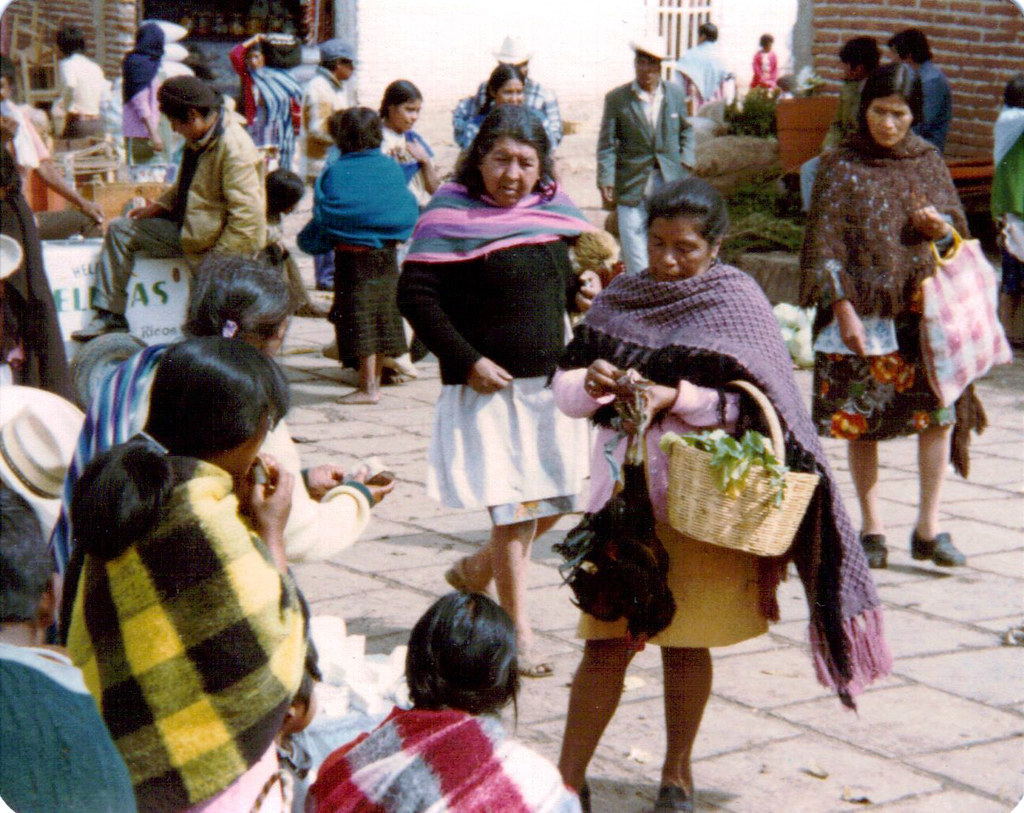
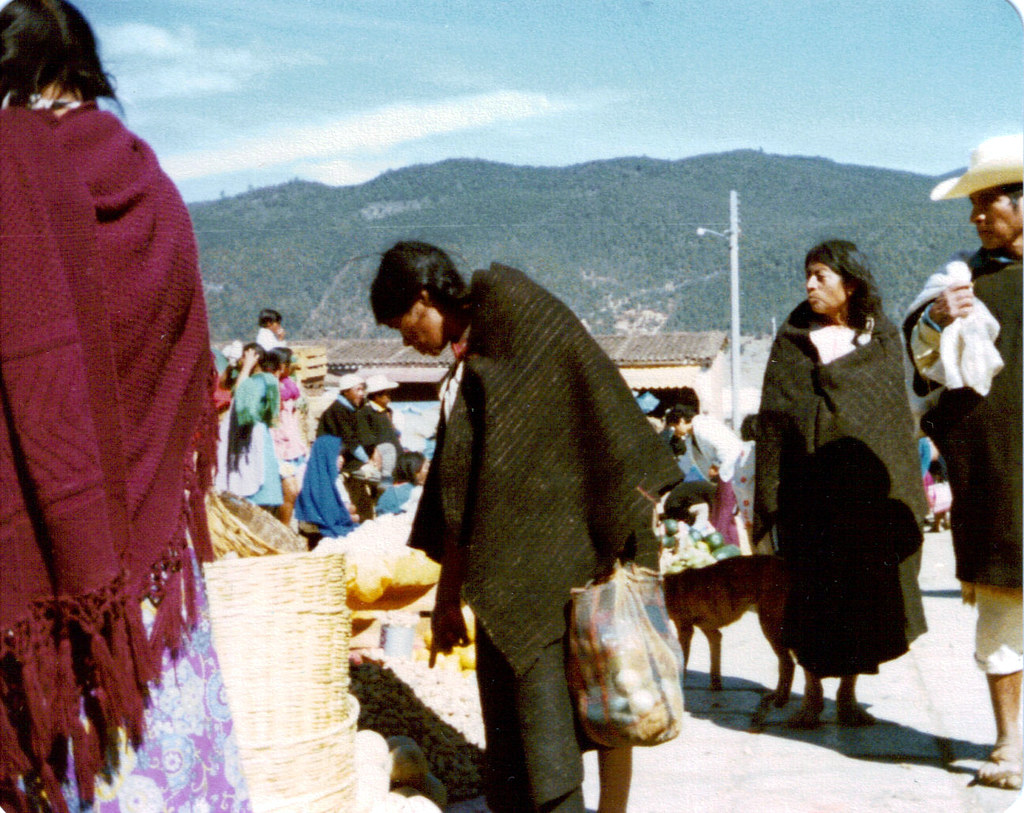
My base in Chiapas was San Cristobal de Las Casas. With its location high in the mountains (at about 7000 feet) and the many Indians who come to market there every day, it’s one of the most colorful places I’ve been in all of Mexico.
There are a number of Indian villages in the area, their inhabitants all descendants of the ancient Maya and divided into two language groups, Tzotzil and Tzeltal. The largest Tzotzil-speaking group are the Chamulans, and their village of San Juan Chamula is the closest to San Cristobal de Las Casas. This is where I went for the first day of carnival which, for the Chamulans, is a celebration as much Mayan in tone as Christian. The celebration lasts for five days, a remembrance of the “five lost days” which occur at the end of the Mayan calendar and which are considered “unlucky.” For that reason, rituals and festivities take place to off-set any bad influences. (1)

  • (1) My experiences in Chiapas and particularly in Chamula were given new meaning by my subsequent reading of Victoria Bricker’s study, Ritual Humor in Highland Chiapas (University of Texas Press, 1973). Using her work, I’ve included a series of explanatory footnotes, offering some insight into the symbolism of the rituals I saw. According to Bricker, “the dominant theme of the fiesta of Carnival in Chamula is one of war and conquest. All of the conflicts in which the people of Chamula have participated are telescoped into this one fiesta.” This extends to include “the domination of the Jews by the Romans and the crucifixion of Christ.” (Page 84)

I awoke at 6:20 in the morning the day the carnival began so I could catch the first bus to the village. There was a heavy, cold mist on San Cristobal, but people were already – coldly – walking about the streets and, despite the celebration, there were truckloads of Indians – Chamulans and the colorfully-clad-in-pink Zinnacantecans – arriving in the market area. From there, at about 7:30, I got into a VW bus (a camionetta) for the ride to Chamula. It only takes about twenty minutes, but the fog lifted and the sun came out shortly before we arrived.

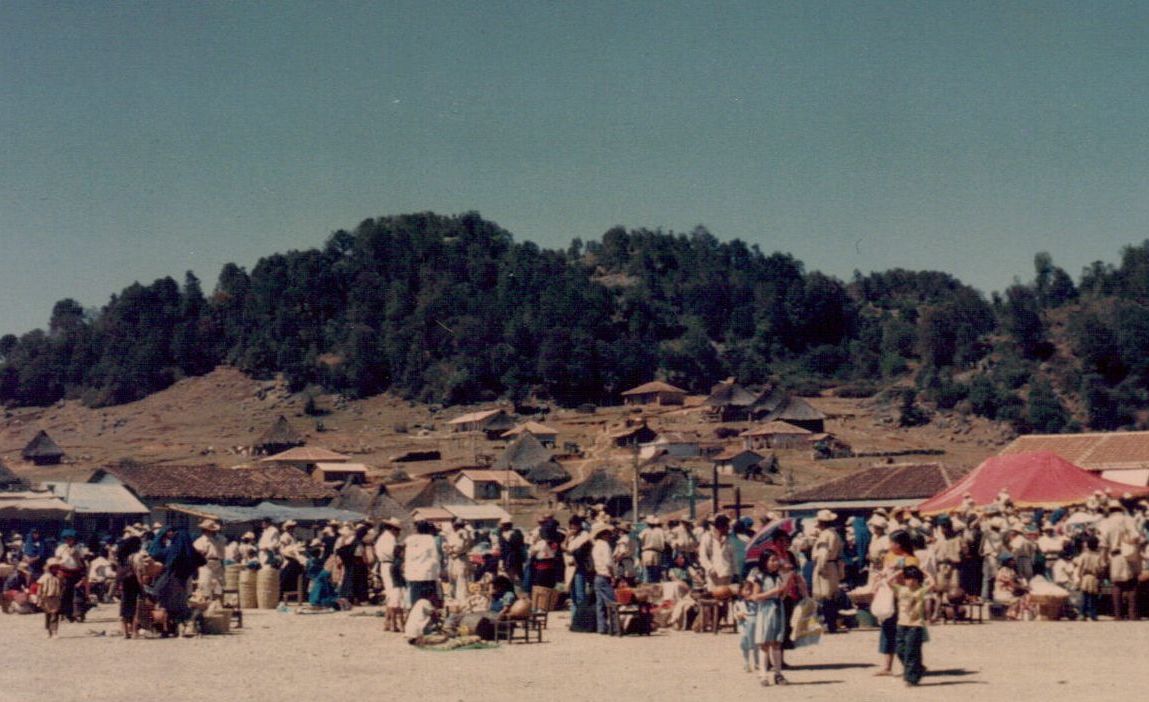
In the center of the village is a large dirt plaza, in the middle of which were a number of people selling fruit and vegetables, radios with Mexican music playing from some of the stands or small tiendas along the sides.

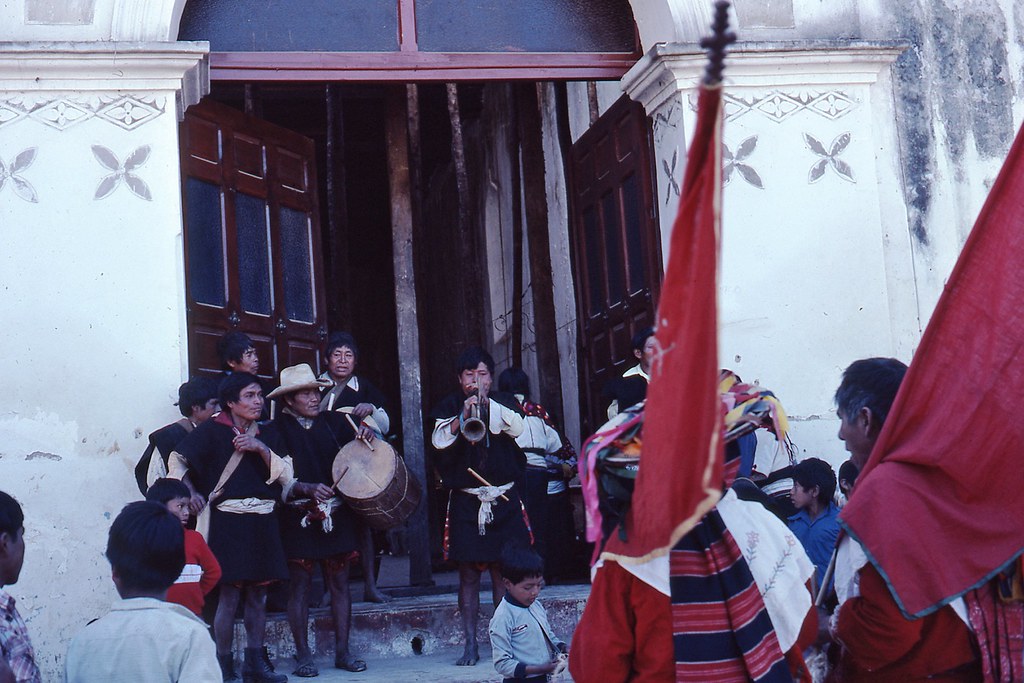
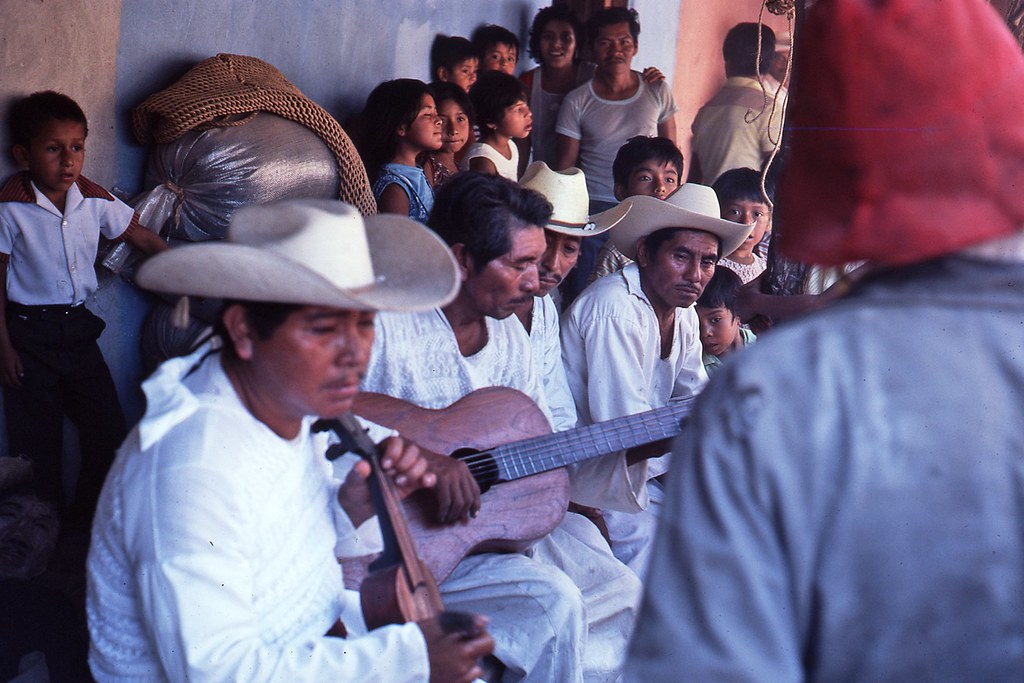
The official ceremonies were already under way as small processions of people were entering the church, set back fifty yards from one end of the square. The processions included musicians with harps (which they carried on their shoulders), guitars, accordions, drums; and women with large clay goblets of heavily smoking incense. And in front of the church, as each group entered, rockets and very loud bombas were being set off. (2)
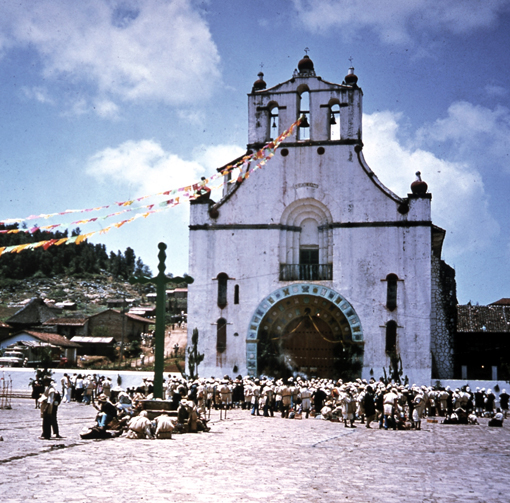

Inside the church, the atmosphere was otherworldly. The area was completely open, the floors were of a sky-blue tile with flower designs, on top of which were strewn large amounts of day-old pine needles which scented everything. The ceiling was high, and stretched overhead were three or four large banners, also with flower designs. (3) Pine trees whose branches had been stripped from the lower half stood on each side of the main altar area, and there were two along the right side of the church. Shining through large arched windows with half-foot square lattice work were two wide, thick rays of the early morning sun, set off and highlighted by the large amounts of incense being burned — and which made it difficult, if not impossible, to see from the back to the front of the church.

There were people in loosely formed groups here and there, each group with its own musicians. All of the musicians played the same song, but not together, rather in time with the needs of what group they were with. It was a slow to medium-tempoed chant-like tune, one of six basic melodies that accompany hundreds of Chamulan songs. (4) The many string sounds fell just out of synch with each other, both within each playing of the tune and throughout the church, the air filled with a gentle but pervasive counterpoint. There were a number of thin, white lighted candles stuck to the floor near each group which were replaced as they burned down. Near the back was a table with many vigil lights burning, and there were people kneeling or standing and praying, sometimes in an aloud incantation.

  • (2) “The symbols of war – flags, drums, trumpets, cannons, and fireworks – are important symbols of the fiesta ritual. Every major event is introduced and terminated by the setting off of cannons and rockets.” (Bricker, page 88)
  • (3) “The flower is the symbol of divinity in Chamula and is in this sense equivalent to the color gold and the halo in Christian symbolism.”(Bricker, page 88)
  • (4) See notes to BATS’I-VOM (see discography below).

As I had entered the church, two men had been standing chanting similarly in the church’s courtyard, and a woman seemed to be performing a healing of some kind on a man seated under a cross in the center of the yard.
Leaning against the wall behind the vigil lights was a tall, white cross reaching almost to the roof. To the left was an arched altar to Our Lady of Guadalupe, above which were small, flashing Christmas lights. Between the cross and the altar was a dark, mystical painting of some kind.

Every now and then, new groups with more musicians would enter, some people carrying large, square chests of dark or unfinished wood. And the women with their pots of smoking incense, which smelled very-much like the pine smell of the floor and very agreeable, would perform a ritual purification of the entire church (5), moving into the corners and around the sides where there were many statues of saints, including one of Saint John the Baptist, after whom the village is named.

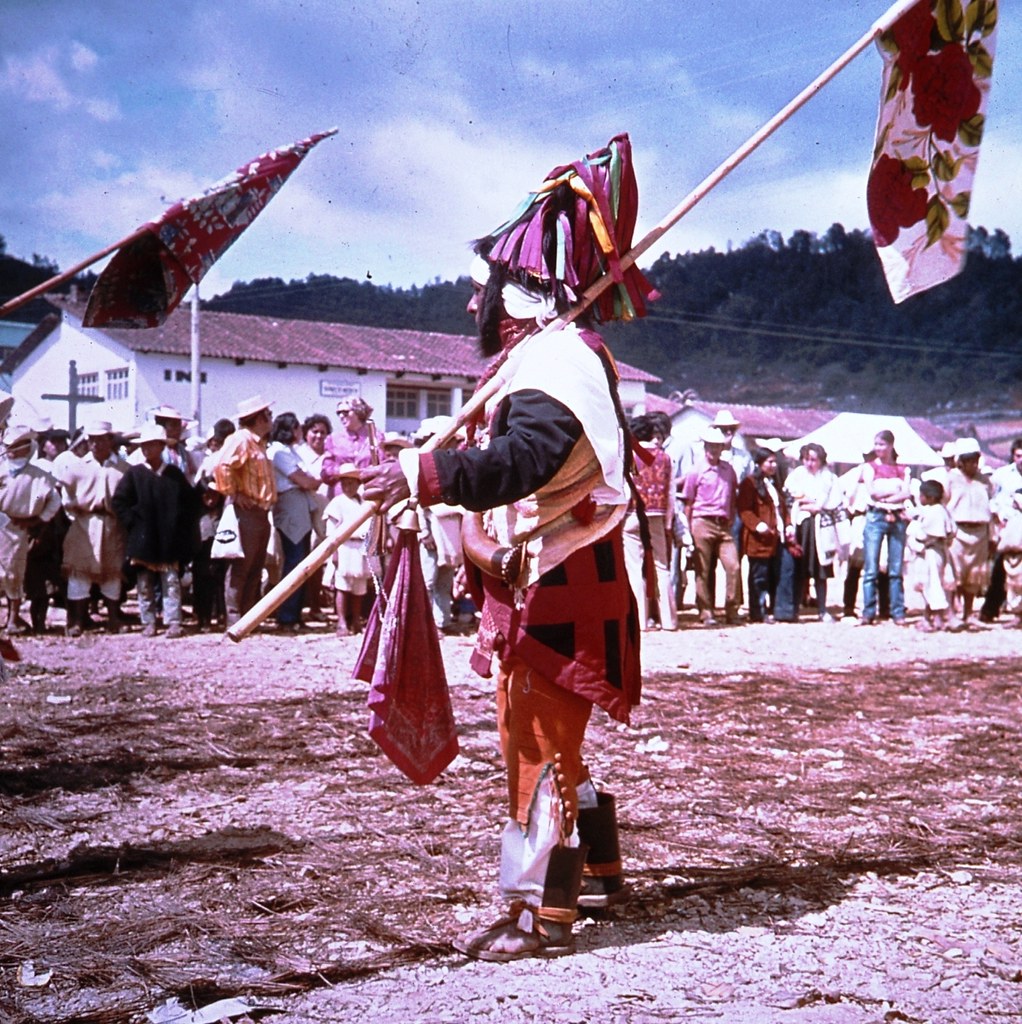
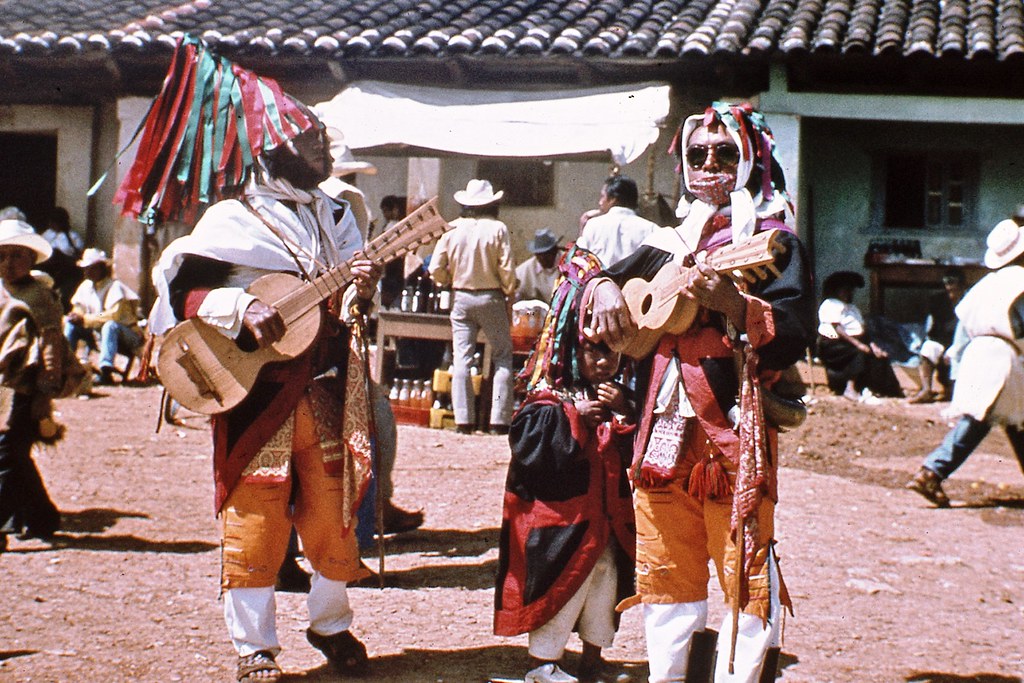
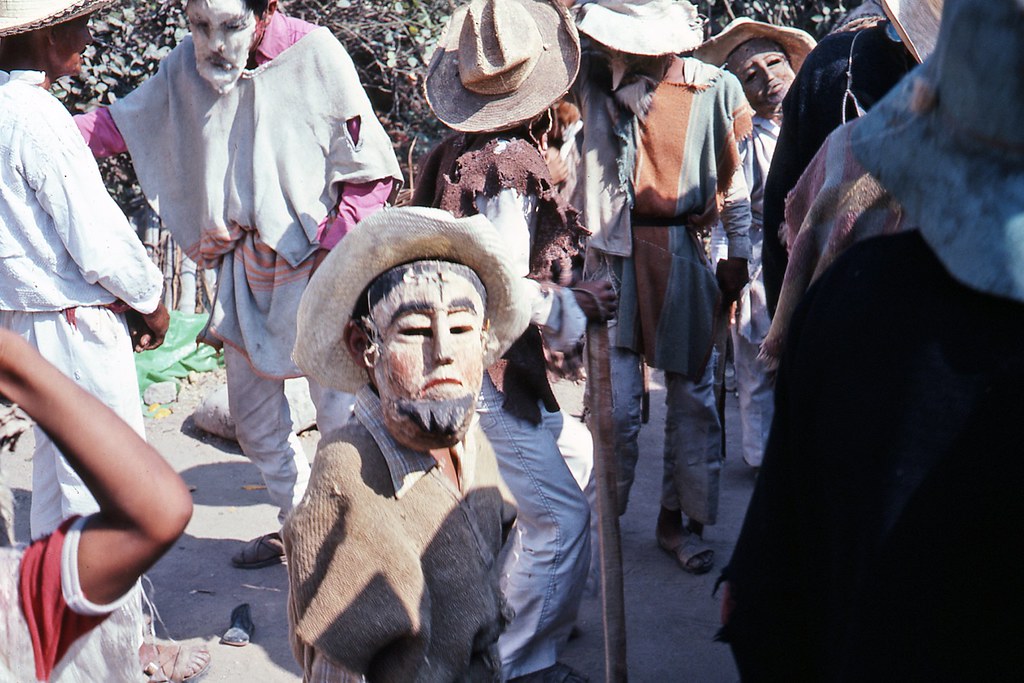
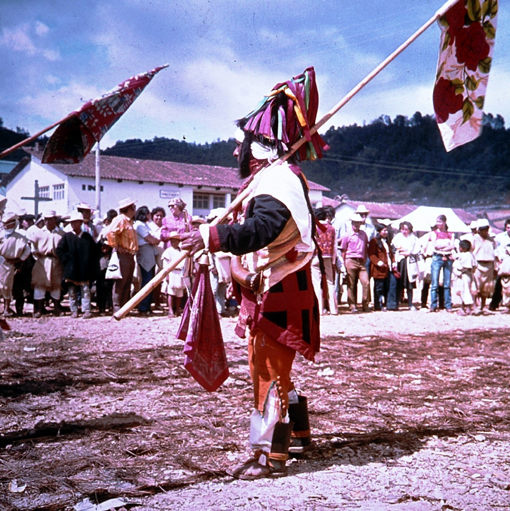
Sometimes, groups of men would enter dressed in tall, black hats of monkey fur from which fell many half-inch wide ribbons of yellow, red, green. Their sandals were backed with a high, black leather piece, like the back of a boot, and they wore something similar to a tailcoat, with wide red and black stripes. On top of this, each man wore something a little different, like a triangular piece of material that came over the back and chest, usually of some lighter color. Sometimes, they would enter playing short, upturned metallic instruments, flat on the sides, that made a loud tone similar to a trumpet. (6)

  • (5) “God ‘eats’ only incense.” (Bricker, page 91)
  • (6) These men are the “Monkeys” who “take over the earth for the five days of Carnival when all kinds of evil spirits are said to appear to perform their awful and obscene deeds.” (Bricker, page 9) “Their costumes are almost identical to the uniforms worn by French grenadiers during the period of French intervention (in Mexico).” (Page 91) But the monkey symbolism is of greatest importance, the monkey being “symbolically equivalent to the ‘pukuh’ (evil spirit) and the ‘h’ik’al’ (Blackman)*… The ‘pukuh’ is black except for his red eyes and penis; (thus) black and red are the colors of the monkey impersonators’ jackets. The Monkeys “also represent demons or Jews, whom a Chamula myth describes as the murderers of Christ.” The Monkeys are also the fiesta’s main humorists. Some are officially associated with the fiesta, but “any man or boy may change his identity for a while, cease to be human, and indulge in animallike behavior (for the time of the Carnival) – the behavior of monkeys.” (page 93) The Carnival is a time “characterized by drunkenness, license, and obscenity.” (Page 9) (* The Blackman motif seems to be a survival of the battle between the Moors and the Christians in Spain. See page 155)

Outside, the rockets kept swishing through the air and the bombas bursting loudly. Often, the bombardiers would go scurrying frantically out of the church so as to set them off at the right time which, in addition to the entrances of each group, was when some of the rituals inside had been completed; and after which would be passed around small, brandy-size glasses full to the brim with posh or aguardiente, a clear, strong rum made in the village from sugar cane and used for all religious and social occasions. Everyone, men, women, and older children would drink.
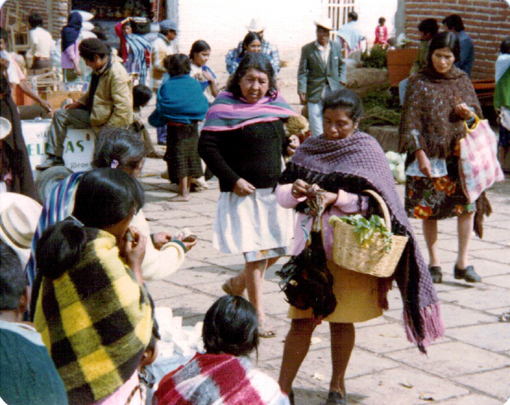
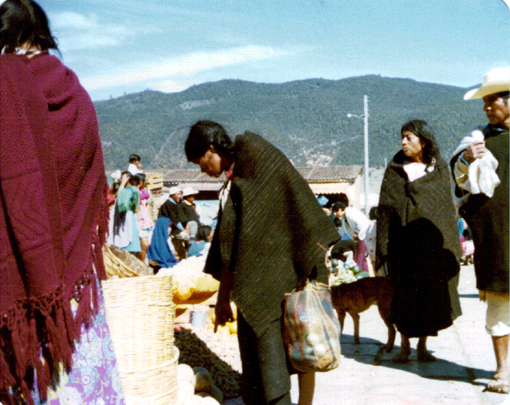
Most of the men were dressed in their usual black or white woolen tunics tied with a belt, leather or material, at the waist. Their shoes were sandals or of very well-worn black vinyl without strings. The women wore skirts of black, with blankets of dark sky blue or turquoise wrapped about their shoulders in which small children were sometimes held or breast-fed. They usually wore no shoes.

The ceremonies involved the ritual undressing and dressing anew of the many statues of the saints inside the church. The new material was taken from the chests they had carried in. The musicians would play, some would stand by shaking rattles, and the new cloth would, piece by piece (and there were many for each statue), be passed by two of the men over one of the goblets of incense and then placed on the statue. Sometimes, the image would be shielded from view by another piece of cloth while this happened. The statue, however, was never completely stripped of its material; the old material was simply removed from under the new.

All the while, the music continued from everywhere, creating a pace and space of its own: the rattles, occasional long blasts of trumpets, incantations, shouts at the completion of parts of the rituals; the clouds of scented smoke rising from here and from there, and the swooshes and explosions of fireworks.

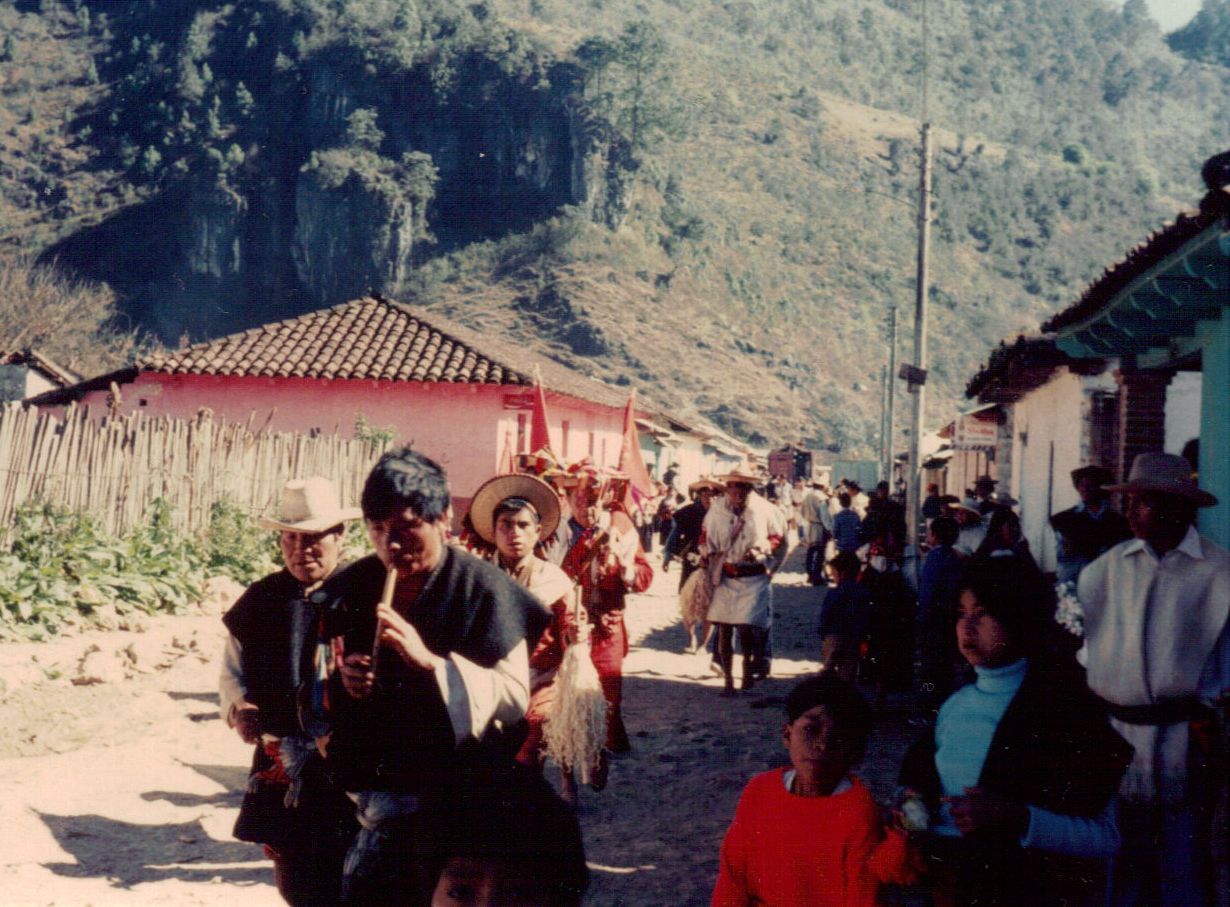
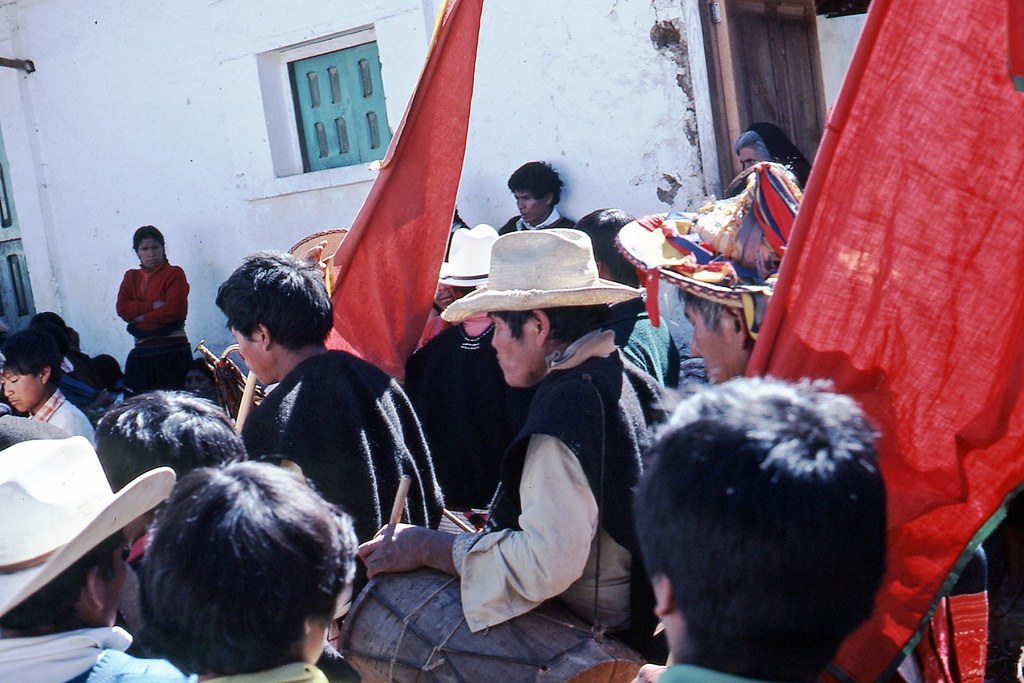
It goes on like this for five days and nights, other prayers and rituals being engaged in after the dressing of the saints. When I left the church, more than two hours later, there were ceremonies getting under way in the plaza. From a street to the left of the church came running some 200 men, most dressed in the tall, fur hats and red and black coats, though some with suits of all red (7) , and many carrying large, colored banners with flower designs. (8) Many of the men had the small metal, trumpet-like instruments which they blew in long tones against each other, and there were others, dressed in normal Chamulan garb, playing large drums and flute and one valveless trumpet (which looked more like an old bronze trombone without a “slide”). They came running into the square, stopping, about two-thirds of the group forming two lines and facing their banners, then continuing on. (9)

  • (7) The “outgoing” fiesta officials (those who have served to organize the community’s events during the previous year) all wear red. “Since in Chamula the color red symbolizes evil, all the fiesta personnel will have to run through fire at the end of the fiesta in order to purge themselves from the evil of having worn red themselves, or from having associated with others who have.” (Bricker, pages 90, 91)
  • (8) “The flag is the key symbol of this fiesta because it represents the spear which pierced the body of Jesus Christ.” The head of the flagstaff, hung with ribbons, is called “The Head of Our Father.” “The cloth banner and the ribbons represent the clothes of Christ.” (Bricker, page 88)
  • (9) “The men run in order” (in three groups, one for each of Chamula’s three barrios). “They are expected to maintain this order whenever they run, for the object of the running is not to ‘win,’ but to symbolize Christ running, with the Jews (Monkeys) in hot pursuit.” (Bricker, page 105) From time to time, the first group stops and waits for the second to catch up so that they can salute them by smacking their flags together. (Page 98)

In the center of the plaza, the market continued, though the people there, mainly women, stood to watch the festivities. The men continued running around and about the square, first in this direction, then that, stopping, saluting, this continuing for twenty to thirty minutes. And above the presidente’s office, on one side of the square, was a small balcony in which were seated thirty to forty men, dressed mainly in black with some red and wearing the black, fur hats with ribbons, and all looking very proper and serious.

After this, I talked with some men in the market place who were selling the Chamulan guitars. With the exception of the accordions they use, the Chamulans make all of their own instruments, both for themselves and other nearby villages. The guitars, like their harps and violins, are made completely of unfinished wood and are held together with some kind of glue. The sound produced is weak, the strings sound as if they’re loosely strung, but in fact they’re not, they’re strung at a normal tautness.

At 12:30, I got one of the camionettas back to San Cristobal.

The next morning, I was up early again, a little after 6:00. It was misty again, but distinctly warmer today. Near the market area, I caught an old school-type bus to the Tzeltal-speaking village of Tenejapa, and had the hour-and-a-half ride standing as the bus was already full when I got on.

Tenejapa is set in a beautiful, green valley just slightly lower than San Cristobal and 180 kilometers to the northeast. It’s more isolated than Chamula, and I felt a bit stranded here at first, being apparently the only outsider in the village.

On a small square where the bus left me off was the church, in totally dilapidated condition. The roof of the back end was off, and long boards and braces just inside the door were supporting its rear upper structure. Inside, the area was completely open, plaster falling from the walls and all over the floor. Small groups of two or three people were kneeling and sitting on their feet praying, chanting aloud, and lighting many rows of the same thin, white candles I had seen in Chamula.

This was also Sunday and the principal market day in Tenejapa. Its main street, a long, narrow, dirt street, was a sea of people. Vendors were sitting for blocks along its tiny sidewalks selling fruit, vegetables, popcorn, peanuts, dried red chiles, sweet bread, and soft drinks.

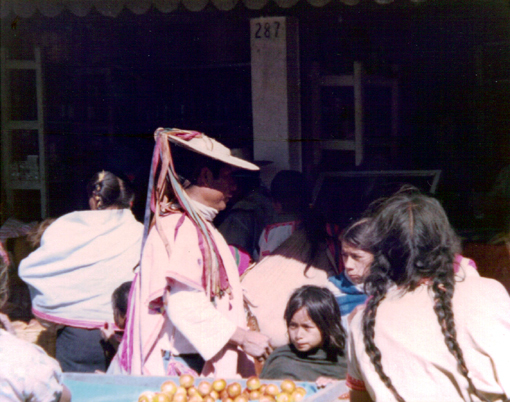
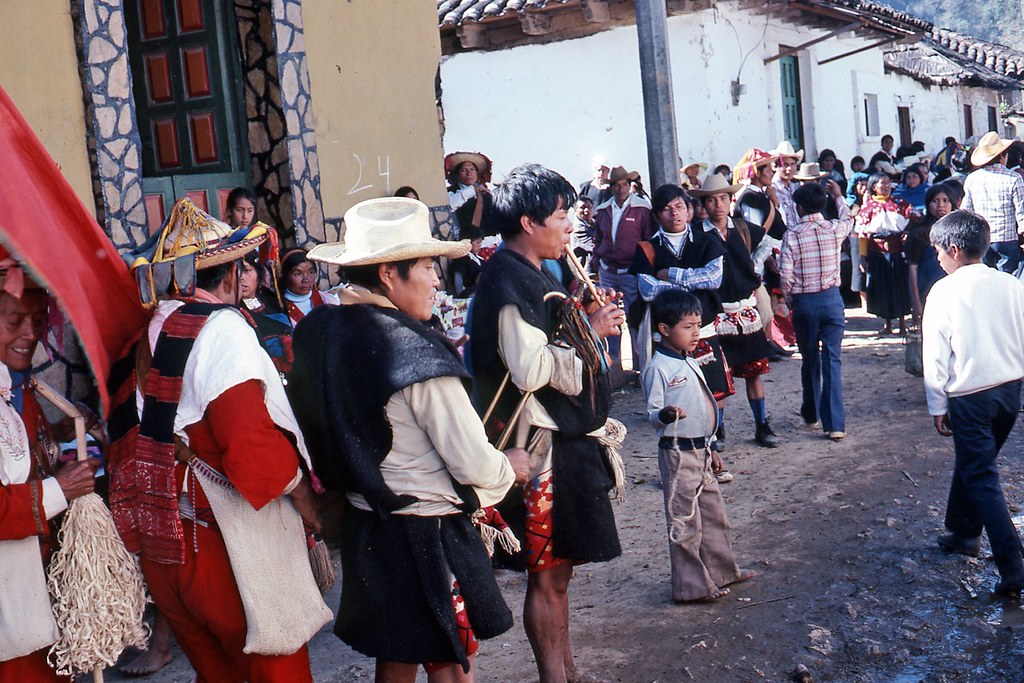
The men were dressed in long, black, woolen tunics with colorful shorts of black, red, or burgundy underneath, their tunics tied at the waist with belts of white and red. Their hats were wide-brimmed straw with a stubby, pointed crown from which fell in all directions half-inch wide ribbons of yellow, red, green, blue, purple. On their feet, if they wore anything, were shoes of worn, black vinyl or sandals.

The women wore skirts of navy blue or black, embroidered in red or white. Their blouses were white with attractive designs of red and black, and they tied wide red sashes about their waists. Around their shoulders were blankets of turquoise, and they wore sandals, tennis shoes, or other heavy shoes or had bare feet.

Some of the man, officials of the village, wore long necklaces, hung every few inches with medallions about the size of a peso which jingled when they moved.

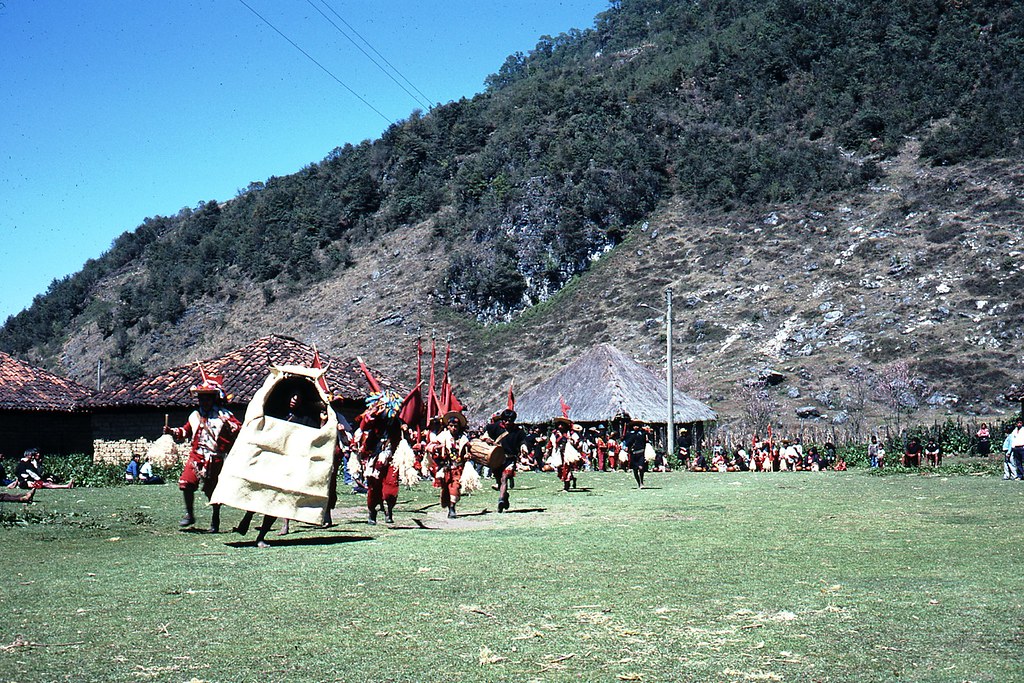
Despite the crowdedness of the street and the amount of activity, it was largely very quiet. At its end, the street curved to the left towards a large, open field which was the end of another street parallel to the market. Here I heard the sound of rattles coming from a nearby house and saw people crowded about the door. I was uncertain whether to approach it or not when I heard from across the field the sounds of drums and flute and saw a small procession of men dressed in red with red banners, and the musicians.
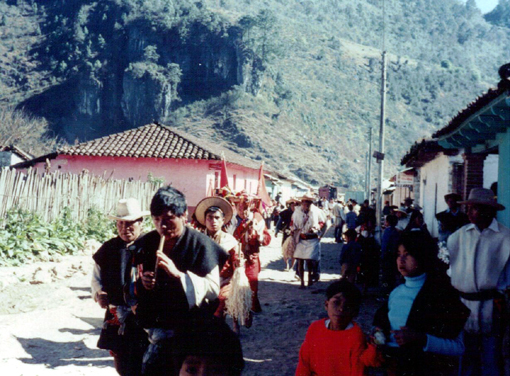
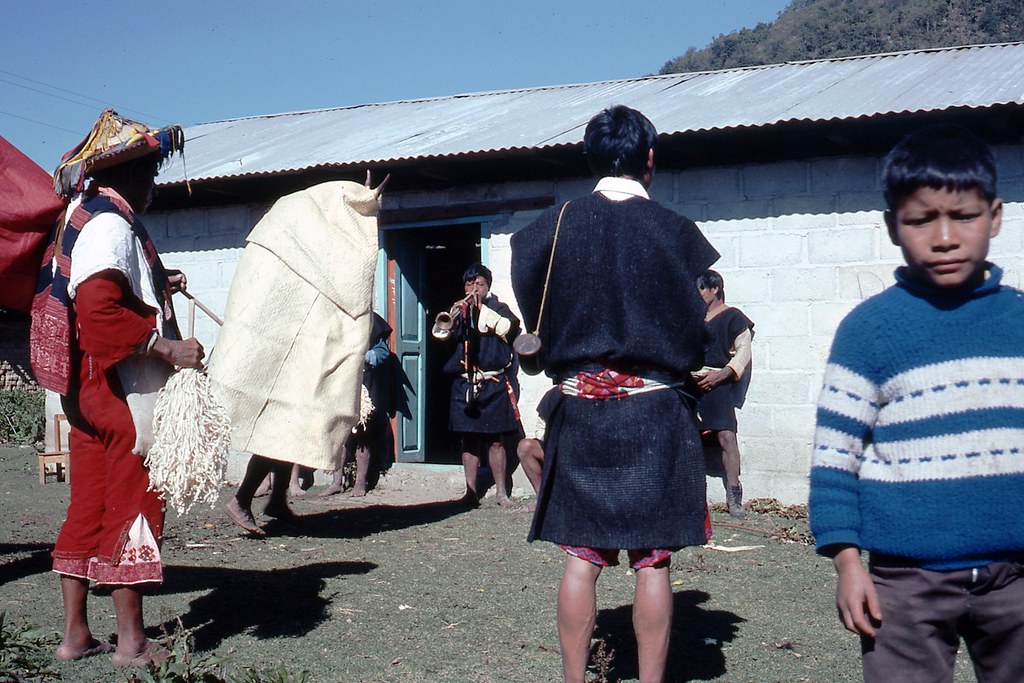
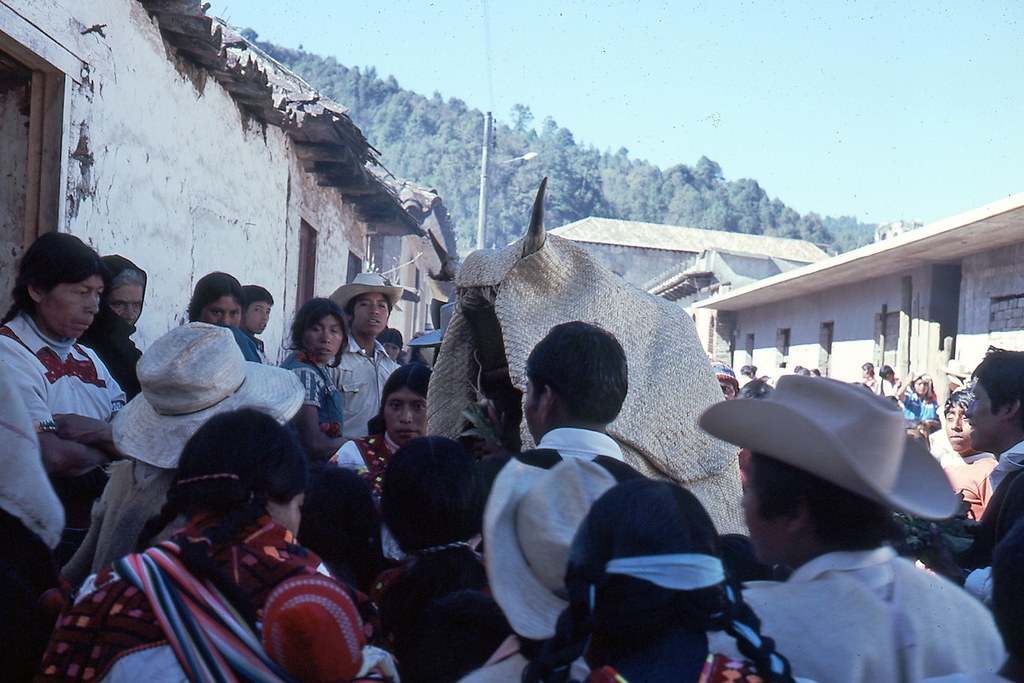
They were led by a man dancing in a strange looking bull costume, which was little more than a boxed, straw enclosure with an opening in the front, horns on top, and a black tail. (10)
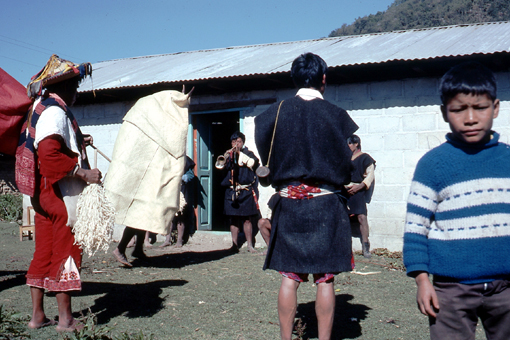
The group proceeded to the rear of a house not far from the house with the rattles, and I moved closer to observe. The man with the flute had one of the large, valveless trumpets with him, and he alternately played that and the flute, while the dancing bull continued moving about.

  • (10) The bull motif seems to be based on a parody of the Spanish bullfight. “In Tenejapa the Bulls are ritually killed on the last day of the fiesta.” (Bricker, page 172)

Then they stopped and began passing around bottles of chicha, a yellowish liquor made from sugar cane but fermented rather than distilled (as is the posh).

From there, the procession continued into the market area, where the dancing bull and the others stopped to obtain gifts of vegetables from many of the street sellers.
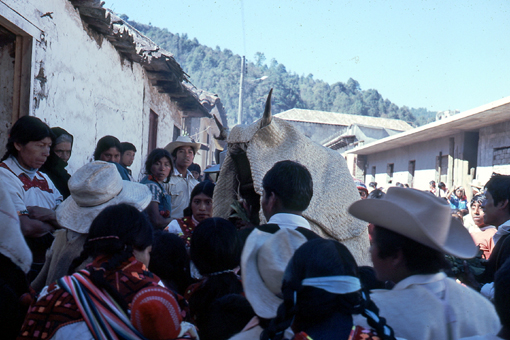
As the bull moved through the market, there were little boys who frequently tried to “lasso” it. The bull was followed by the musicians, who were followed by the men in red with banners, who were followed by four other men, two of whom were dressed in white and intoned a slow chant the whole way. The flute played a low-profiled, sliding and haunting melody, occasionally punctuated with half-toned trumpet blasts and to which the drums sounded a deep, dry and regular rhythmic accompaniment.
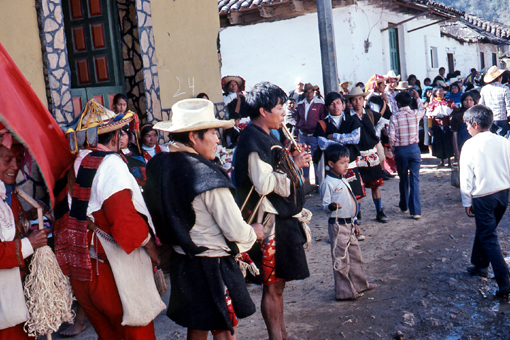
At the end of the market, the men walked to the steps of the church where prayers were said and music played, then back down the market street and up each side street.
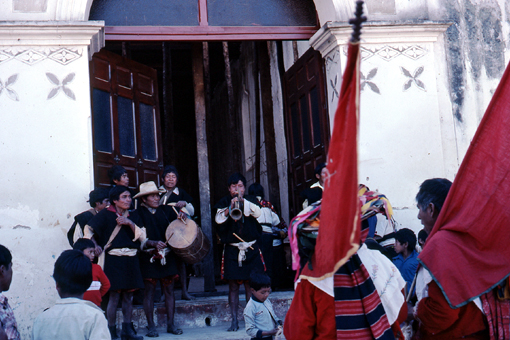
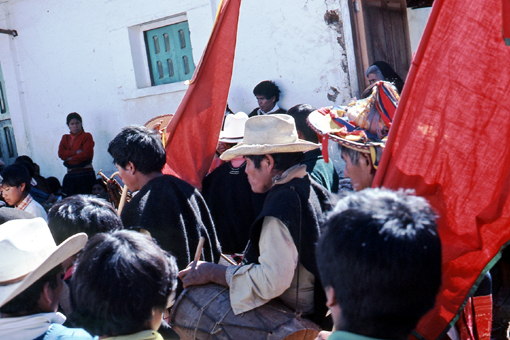
Here they stopped at the intersections, many of which had small, stone crosses near the corners. The musicians knelt and played while the chanting continued. Finally, they returned to the open field and were led in procession around it by the dancing bull. They then stopped and more liquor was drunk. And by this time, perhaps an hour later, the group I had heard with the rattles had moved outdoors, and a crowd had gathered. So I walked over to see what was happening.

There were eight people dancing with rattles. Three or four of the men wore rubber, carnival-type masks, two men and one woman were without masks and dressed in the women’s garb I described earlier (11), and there was another man in a beige, furry-type mask.

  • (11) “Female impersonators are the ritual humorists of Carnival in Tenejapa… They dress as Indian women in skirts, blouses, and belts and are accompanied by men masked as Ladinos, in blue denim overalls, who pretend to be their husbands. In Tenejapa the female impersonators are called Dancing Ladies and the Ladino impersonators are called Ladinos. The female impersonators engage in sexual joking with the officials and spectators. The Ladino impersonators carry wooden knives and rifles with which they pretend to attack the spectators who try to touch their wives’.” (Bricker, page 172)

There were two musicians playing a highly rhythmic melodic line. It was a tune I recognized from the records I have at home. One man played a short, natural wood violin, dark with age, three strings only, flat at the end. He used a short, stubby bow, producing a generally weak, scratchy tone. The other man played one of the large Chamulan guitars, also dark and with only three strings operating. He played it upright as a bass, both men sitting in small, stool-type chairs with backs (these were also used by the musicians in the church at Chamula).

This gathering was one of high and, at times, vulgar if good-natured humor. Naturally, as an outsider, I became an easy and immediate target. “No tiene una camera, si?” said one man, and another said something in English about Washington which I didn’t catch, and they said other things, both in Tzeltal and Spanish which I didn’t understand, but which caused a great deal of laughter.

What followed was a lengthy two-man improvisation, one man with a rat-like mask with thick, black moustache and black eye patch, the other with a monster-looking mask, black “hair” on top, flesh on the bottom, large red lips, and protruding white teeth. They made hilarious fun of each other, gesticulating wildly, which had everyone roaring with laughter.

Every once in a while, I would glance into the field at the “procession,” now having been joined by more villagers dressed in red with banners. It seemed to be stopping more and more often, the men consuming larger and larger amounts of the chicha. Then they decided to run up and down the field, the drummers playing while running, led again by the dancing bull.
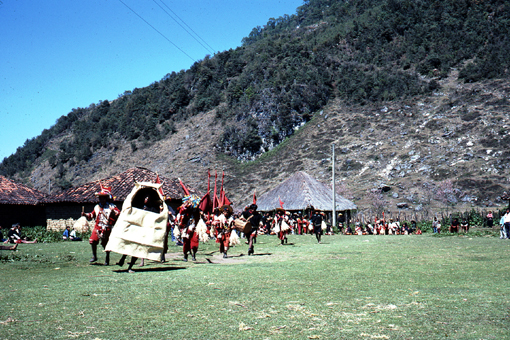
I watched them for as long as they did this, perhaps ten minutes, then wandered back into the market area. At 1:00 o’clock, I got one of the camionettas back to San Cristobal.

What I’m impressed with these two days in Chamula and Tenejapa is the way that music functions in these villages. It really has no life of its own. Rather, it is only part of a larger fabric, a religious and social context which it helps in part to make up but which is also its justification for being. This context is what the Indians refer to — almost reverently — as costumbre or “custom,” which is their manner of speaking of all which they perform and repeat as ritual. So the music operates in a very closed system and I’m struck, both in Chamula and Tenejapa, with the absolute similarity of the music I heard in the villages with the recorded music I have on LP, recorded some four to eight years ago. So there is no noticeable dynamic at work pushing the music to be anything else than what it already is or has been for many years.

Yet there was something absorbing and even unusual about it. The attractiveness of the melodies, for example, often belied their repetitiveness. And in the way in which the instruments combined and in the general scratchiness of their tone, there was an underlying rhythmic jaggedness to the music and implicit harmonic openness which generated a good deal of inner tension. Its seemingly preferred not-quite-specific time, pitch, and timbre within an otherwise entirely specific song form portended an explosion of sorts of its simpler, closed structures — not one likely to take place, by any means, but there by suggestion nonetheless. (12)

  • (12) Naturally, the music is specific to itself in terms of its own intonational preferences.

I’m also struck, in Chamula especially, with the power of the music in its own ritual environment, the way in which it functions as vibration alone, clearing a very pure space simply in its repetitiveness and repetition over a long period of time.

There is in it too a feeling, a feeling which comes out of a culture whose people literally have their feet on the ground. It translates as a deep self-assuredness, a self-completion in the music which exists totally without need of outside response (though it is, of course, in the context of the costumbre from which comes that other feeling of it being just a bit too settled, too comfortable, its rate of vibration remaining largely constant).

The next day, I took the 10:00 o’ clock bus to Venustiano Carranza, a small town of (I’m told) 38,000 people some two to two-and-a-half hours due south of San Cristobal. It’s very warm to hot here, but the town is hilly and set on a hill and you can still see mountains in some directions, so I have no idea of its altitude. The town is unique in that it has a large Tzotzil-speaking Indian population living immediately within its confines rather than in a separate village.

Carnival festivities were going strong as I walked into the square about 1:00 in the afternoon. A marimba band was playing and folks, masked and in home-made carnival outfits, were dancing. There was also a humorous skit of sorts that appealed mainly to the children.

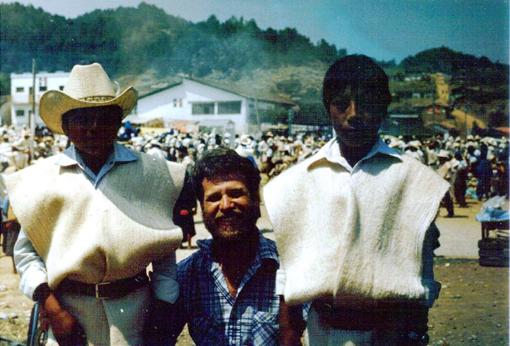
This, however, was a town celebration rather than an Indian celebration, even though many Indian men (including some musicians who seemed to have played earlier) were also in the square. They wore all-white pants held at the waist by a red sash, and white tops which hung over the pants and on which were rows of busy geometric designs interspersed with ones of flowers or animals. And they wore straw cowboy hats and leather sandals.

I realized, though, that I would have to go elsewhere to find what music I was looking for, and one of the men pointed me in the direction of the Indian barrio.

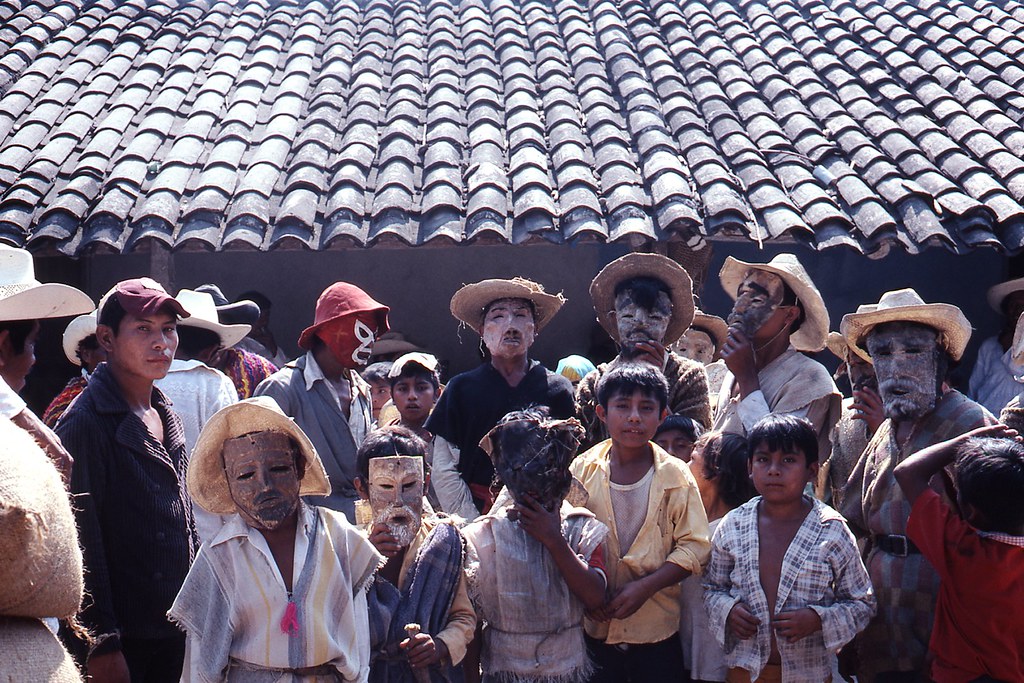
Even though I approached the task at hand without too much initial hope, I almost immediately came upon a small parade of men dressed in white, including two musicians, and a number of teen-aged and younger boys in shaggy carnival outfits and home-made masks of rubber, wood, or cardboard. Some of the masks, especially the wooden ones, were quite elaborate and old with old men-type faces.
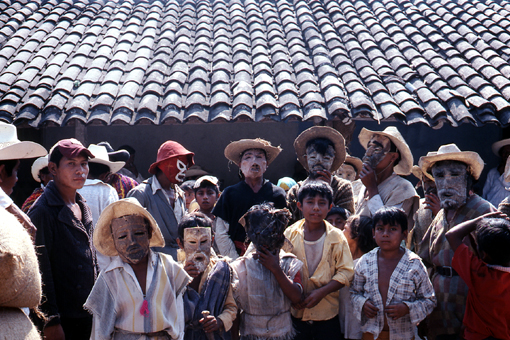
The group proceeded up a small alleyway to a backyard, and I followed, being assured by one of the men that it was alright. Here I learned that the carnival celebration was in its third and final day, and I realized that a number of the participants were fairly drunk. The music here, of guitar and violin, was of special interest, certainly the freest music I heard in Mexico in any harmonic sense and, in that way, the most unorthodox. Here again, though, the structures were completely pre-prescribed and the music very similar to some of the recorded music I had heard from this town.
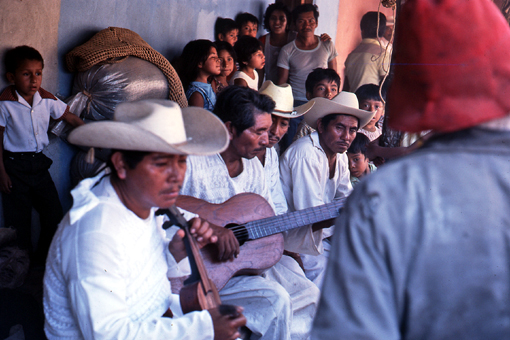
The two instrumentalists worked in widely different, if complementary, musical spaces, the guitar providing a low, relatively fast, and roughly chorded rhythm while the violin (played upright) moved circularly through a much higher-pitched melodic line, cutting sharply through it with a sandy, slightly sour, tone.
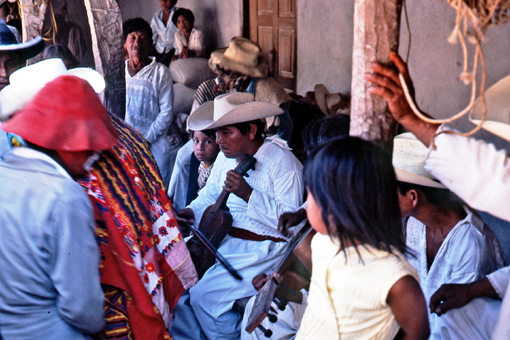
So there was more of a pulling this way and that which, if it had been pulled just a bit more, might have quite thoroughly blown the whole musical cover. As it was, it was a highly rhythmic music, though to some ears the pulse would have sounded ragged and subtle.

But people danced to this music, jumping up and down to it the same as you might see at any party in Berkeley or San Francisco. (13) But when I say “people” danced to it, what I mean is that the men, the carnival-attired men (boys), danced to it. There were no women involved in these festivities, though there were many ten to twelve-year old girls about, and younger boys too, and several married women.

  • (13) This actually seemed to be a variant of one of the Old Men type dances common throughout Mexico, and several of the participants danced stooped over canes. Although sometimes performed to ridicule the Spanish, the prototype of the dance is “clearly pre-Columbian in origin, having affinities with the Aztec dance of hunchbacked old men.” (Bricker, page 201)

The women were attractively attired — in long, straight dresses of navy blue, beautifully and quite elaborately embroidered in designs of bright pink, yellow, green, blue. The designs were at the bottom of the skirts and at the sleeves, while rows of light-blue geometric patterns set against white decorated the bodice. Sometimes, they wrapped brightly colored blankets about their shoulders, of green, yellow, orange, black.

But here, as was also the case in Chamula and Tenejapa, all of the official celebrating seemed to be done by the men only, though at Chamula the women did take part in the ceremonies in the church.

The ceremonies here were also the most “secular” of any of the costumbre I encountered, though there were likely other religious ceremonies that I missed. Apparently, the procession of musicians, men, and masked participants had been making various house calls for each of the three days of festivities, and after an hour or more at this house — and a good amount of passing of bottles of “posh” (which I shared) — the procession began again to go somewhere else.

We wound our way further into the barrio, leaving behind the paved streets and walking up and down dirt pathways into some scenic and mildly tropical hill country with houses of adobe and thatched or clay roofs.

At our next stop, the music began again and there was more dancing, some of the neighboring families coming nearer or standing outside of their houses to observe. Sometime after 5:00 o’clock, I left. I was glad to have had the opportunity to hear some of the music from here first-hand and, once again, to be able to get a sense of its context. Yet here, as in the other villages, there were similar formal constraints; also, as part of the celebrations, a general overuse of alcohol and implicit belief in its necessity as a social glue and means of release from ordinary consciousness.

In all of this, as in all of the rituals I encountered in Mexico, there was great power to create the moment and much, by implication, in the music. Yet here and elsewhere, the feeling of insularity of the cultures was continually present, simply as a quality or tone or inner resonance of the music and rituals.

So, for me, in the end, the rituals became demystified. I saw them, as I felt they were seen in the communities themselves, as more ordinary rather than extraordinary events. And that, paradoxically, is a good part of both their strength and weakness: there is a real and shared clarity of context (earthen in tone) which, when it is fully able to penetrate itself, becomes its own inherent self-completion; but which, when it is not, remains little more than captive to its ages-old self-imposed limitations.
Text, Drawings, and Photos Copyright Henry Kuntz Jr.
Thanks to Martha Winneker for help in editing the manuscript.

Discography

  • Modern Maya:The Indian Music of Chiapas, Mexico, Volumes 1 and 2 (Ethnic Folkways FE 4377 and FE 4379). High quality, on location, stereo recordings by Richard Alderson.
  • NA-BOLOM DISCO NO. 1
  • BATS’I-VOM (NA-BOLOM DISCO NO. 2). Disco No. 2 features music of Chamula while Disco No. 1 offers selections from other area villages. Available from NA-BOLOM, Centre de Estudios Cientificos, San Cristobal de Las Casas, Chiapas, Mexico. (Disco No. 1 may be out-of-print. My copy is also packaged identically to and with the notes for Disco No. 2.)
  • FOLK MUSIC OF MEXICO: Music of the Cora, Seri, Yaqui, Tarahumara, Huichol, Tzotzil, and Tzeltal (Library of Congress AFS L19). Recorded and edited by Henrietta Yurchenco. This is a record I’ve only recently come across. It contains five pieces from the Tzotzil and Tzeltal Indian areas, although specific villages are not identified. The recordings were made in 1945, and particularly instructive is a comparison of the third of the five pieces with the same piece as it appears on band 2, side 2 of NA-BOLOM DISCO NO. 1. Although the flute line — over a period of thirty years — remains virtually the same, with minor pitch variations, the differences in feeling between the two pieces and, particularly, in rhythmic emphasis and placement are significant. Note also the unusual simultaneous flute and trumpet lines on the second of the five pieces.
  • For this journey, I consulted Mike Shawcross’s City and Area Guide to San Cristobal de Las Casas.

Fresh Sounds from the Bay

There’s a tremendous amount of musical activity in the San Francisco Bay Area right now, more than one person can keep up with.

On a recent Saturday evening, while Evan Parker appeared with pianist Greg Goodman in Berkeley at the opening of a series of performances celebrating thirty years of Woody Woodman’s Finger Palace, the “XXXth WoodTenniel,” across town in Oakland there was a new presentation of Tom Djll’s “politically expedient musical” Mockracy featuring no less than twenty stellar local improvisers.

On the following evening, while I was joining the trio Wiggwaum for a show at San Francisco’s Hemlock Tavern, Mockracy continued in Oakland, and Gino Robair mounted an encore performance of his opera I, Norton at SF’s Community Music Center. There were also performances at the Musicians Union Hall in San Francisco presented by Rent Romus and Outsound and at Studio 1510 in Oakland.

Two days later, when guests Paul Lytton and Nate Wooley joined Mills composer-in-residence Fred Frith for a collaboration at Oakland’s 21 Grand, the show was followed by an after-hours event at the nearby Uptown Club by the quartet that appears on the CD Jus.

This is all to say that while my intention is to alert you to some of the wonderfully fresh sounds happening in the Bay Area, what I have to share with you is by no means exclusive.

Poor School / Wiggwaum (Killertree Records) is a first release by two distinctive trios in a combination LP and CD. Poor School is Bryan Ramirez – electric guitar, Nathan Hoyme – reeds, John Niekrasz – drums. Wiggwaum is Randy Lee Sutherland – drums, Douglas Katelus – Fender Rhodes electric piano, Loren Means – amplified trombone, flute, and voice. One continuous side of the LP is Poor School, the other Wiggwaum; the enclosed CD features the LP material in digital format along with an additional track by each group.

The playing is high-intensity throughout, though there are fundamental differences in each group’s musical approach. I’ve come to think of their respective approaches as symbolic of something like post-nuclear morning and evening ragas.
Poor School will wake you up and not take you down. Their modal and thickly drone-based song is awash in a sea of harmonics. Their music seems like a throwback at first, but it’s only that there’s a timelessness at the spiritual core of it. Ramirez’s high-strung electric guitar pyrotechnics most often take the lead in the trio’s rock-solid amalgam of ecstatic psychedelic jazz.
Wiggwaum shapes sound inside a nebulous cone of white noise from outer space. Their music might change your evening or your life. While its particles are made up of “real” sounds derived from real instruments, it is pushed to such a level of intensity that only a massive sound entity remains.

Randy Sutherland’s drums loosely thrash, crash, explode, and dryly implode within the sonic mush. From Doug Katelus’ Fender Rhodes come jangly runs of Ra-like “cosmic tones” or warbly layers of static-y stratospheric dis-chords that shatter and whir upon terrestrial re-entry.

At the center of the maelstrom are the distorted voice, feedback flute, and mutant trombone of Loren Means. You might recall Loren’s playing from Henry Kaiser’s Ice Death (Parachute 005). Loren’s new brass sound is like nothing you’ve heard, a muffled foghorn to guide approaching aliens. Combining crescendo-ing and decrescendo-ing globs of sound with Martian voice and Theremin-like feedback, Loren’s playing gives shapeless shape to Wiggwaum’s edgy next-age noise music.

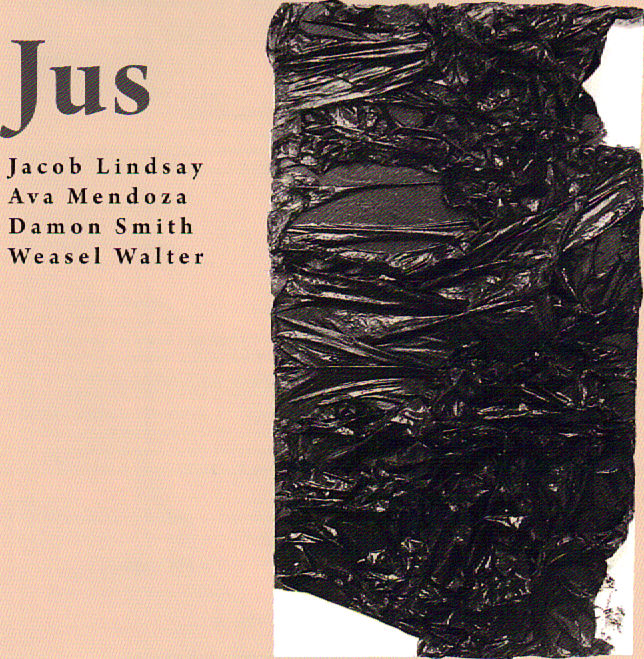
Jus (Balance Point Acoustics) is a quartet with Jacob Lindsay – clarinets, Ava Mendoza – guitar, Damon Smith – ergo string bass and lloop software, Weasel Walter –drums. Walter’s presence on the CD, along with enclosed instruction to play it “at high volume” has one thinking that this might be another high-propulsion free jazz blowout. But Jus offers music of another sort, something unique to itself.

It is music that is continually probing beneath its own surface, extracting unassuming yet purposeful sonic core samples from its oceanic depths. The sounds are low-level, deliberately dynamically uneven, but occasionally something hard is struck, and there are loud explosive bursts and eruptions.

If there is an antecedent for Jus’s musical approach, you might find it on “Translucency” where, at its most active, the music calls to mind that of the Music Improvisation Company of the early 1970s.

Jus undertakes a total group approach to improvisation. Save for Jacob Lindsay’s short Giuffre-like clarinet lead that stands in high relief on “Discrete Flavor Symmetry,” there is little in the way of individual motivic development. Yet the music engages us because despite its lack of linearity, there is held tension in the lack of line itself, in the multiple little dramas that emerge in its intervallic spaces.

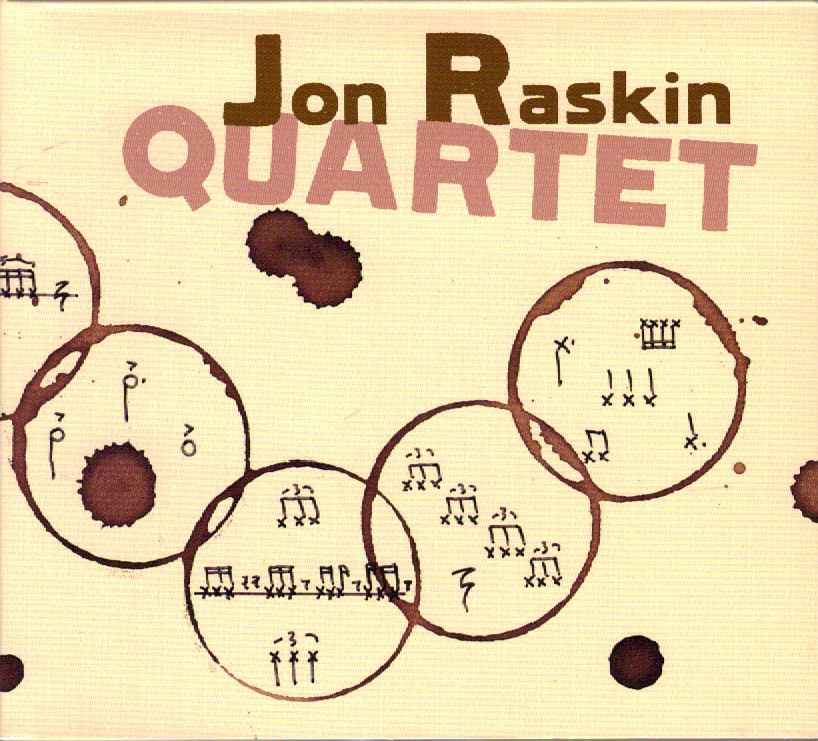
The Jon Raskin Quartet (Rastscan) features Liz Albee – trumpet and percussion, George Cremaschi – bass and electronics, Gino Robair – percussion and electronics, Jon Raskin – saxophones. There are twelve pieces of music, several based on specific-to-open graphic scores created by Raskin, others completely improvised.

Of the compositions, Raskin writes: “The scores are an ongoing attempt for the musical ideas and inspirations to be on the page rather than an abstract road map….Each work has a unique set of sounds, strategies and ideas given to the visual elements. Some of the elements in the score are composer defined while others are what I call ‘self composing’ where the musician decides on the material for the performance. The intent is to give shape and consistency of form for the ensemble while leaving open the path for individual language and perspective.”

The musicians are well chosen for that task and for their adeptness at collective improvisation. In fact, there are no real solos in this music, only continually evolving group interplay of the highest order. Individual virtuosity is fundamental to the quartet’s contrapuntal improvisational approach, but it is tempered by musical necessity. What we hear in the music are lines and riffs, weight shifts, and textural openings. Any player may stand out at this moment or that, but the integrity of the music as a whole is what we hear.

I also found myself thinking of certain music of Roscoe Mitchell’s or that of the early Art Ensemble of Chicago while listening to this CD, in the way the music devolves from line to pure sound and back again. It is interesting that in this context Gino Robair’s “deconstructivist” approach to percussion frequently leads directly back to the “little instrument” sounds of Mitchell and the AEC.

There are equally compelling contributions from Jon Raskin himself whose manner of understatement or of tonal pivoting can remind one of Mitchell; from the undersung George Cremaschi whose bold fibrous bass tone holds the music’s firm center; and from Liz Albee whose trumpet first conjures up Don Cherry, then whispers, growls, purrs, or can sound like an aggregate of children’s squeeze toys.

Zen Kaiju is an intriguing new CD featuring Kiku Day – ji-nashi shakuhachi, and Henry Kaiser – electric and acoustic guitars.

When Henry handed me this CD, he told me he thought this was one of his best recordings ever of pure free improvisation.

But what is at the core of free improvisation, and how are we to judge it? After all, free improvisation is only one method among many for creating music. But it is the most open method, one that suggests that while it is possible to play almost anything, what that “anything” is will be determined in the moment of musical transaction. The self that enters into and surrenders to such a methodology will not likely be the same self who comes out of it at the end. For what is built into that open way of creating is an inherent propensity for change, an opportunity on each and every occasion to renew and rediscover the self and the self in relation to others. The idea is not simply that the players should engage as musical chameleons but as full, present, and evolving selves.

That is what Henry Kaiser and Kiku Day do masterfully on Zen Kaiju.

Kiku Day takes that most ancient of Japanese flutes, the shakuhachi, into new dimensions. Mindful of the still center of the instrument, she merges its traditional plaintive call with seeming electronic slivers of high-pitched sound, dynamic whooshes, breathy and growly wisps, mouth noises, strange percussive tongueings and tappings.

Henry Kaiser’s post-Bailey guitar slows down, becomes charged and evocative. He bends and alters his phrases, strums successions of stringy, twangy slack tones, flicks quick starry clusters of notes into incongruous orbit. On electric guitar, he holds in place big chunky motorboat chords; he sustains into infinity loud wavery-to-pure tones, cries, and wails that at times mimic Day’s shakuhachi.

Henry Kaiser and Kiku Day — between them emerge moments of interactive clarity that reveal the essence of their musical personas. Their mastery of free improvisation is revealed.

Henry Kuntz (November 2008)
(Thanks to Martha Winneker for editorial assistance.)